There’s always that one movement in a band routine that feels optional. The one that looks a little weird, takes more coordination, and makes you wonder if it’s doing anything at all.
For my daughter, that was the Diagonal “Throwing Pattern” Pulls.
I swear she gave me a full middle-school eye roll the first time her coach introduced them, like great, another band thing… can we be done yet?
But her coach insisted.
“These are the closest thing to strengthening her actual pitching motion,” he said.
Not the big muscles.
Not the flashy ones.
The stabilizers that control the whip.
So she added them. Daily.
And I don’t say this lightly: it changed her pitching more than anything else she did. And it took resistance bands. We bought some cheaply on Amazon, but you can get them from any sporting goods store.
Why She Started Doing Them in the First Place
The problem wasn’t effort. She had plenty. The issue was control, tiny pieces of her arm circle that drifted off-path when she got tired. Her timing would get a half-second late, her whip would flatten out, and everything would start landing a couple of inches lower than it should.
Her coach noticed her shoulder wasn’t rotating cleanly through the throwing plane.
She was strong forward and strong downward… but weak diagonally, which is where the magic actually happens in a windmill.
Diagonal pulls mimic the real pattern of the shoulder girdle during a pitch.
Not “sort of like pitching.”
Not “good for pitchers.”
Literally, the movement pathway the shoulder follows when she throws.
Once she heard that, even she stopped rolling her eyes.
What These Pulls Actually Do (and why they matter more than you think)
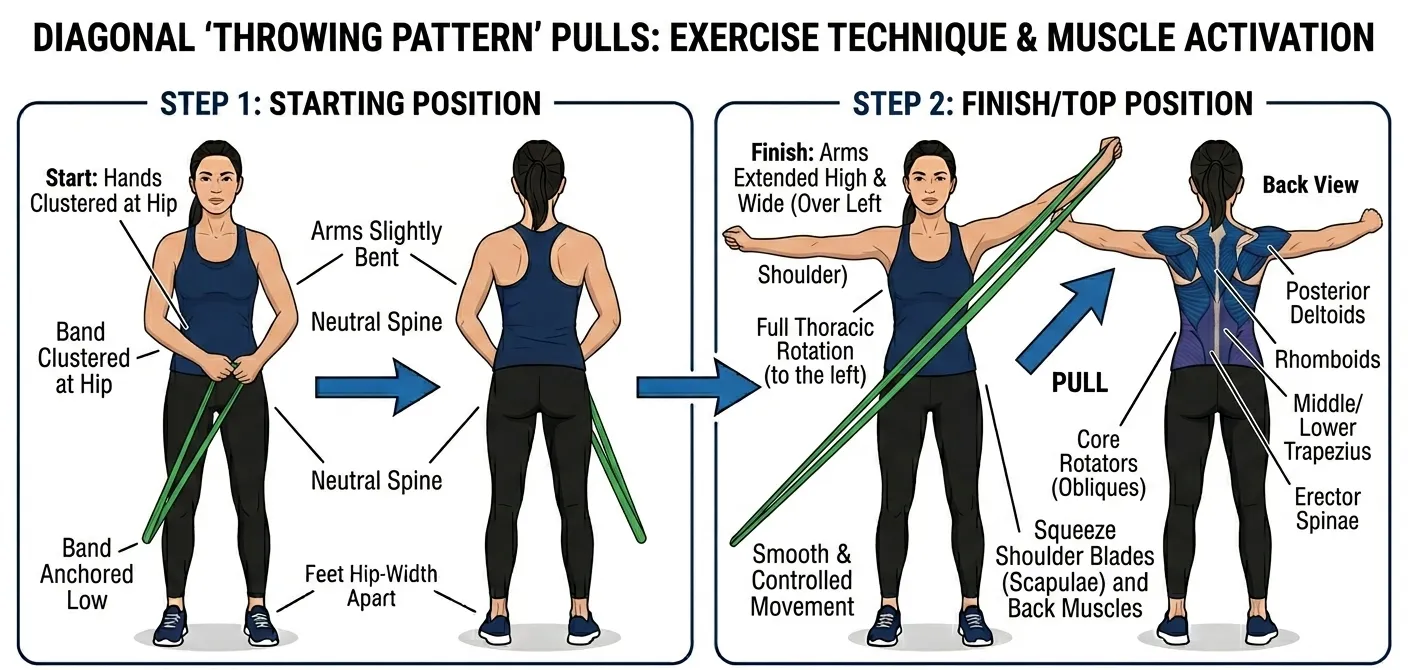
If external rotations are the rotator cuff’s toothbrush, diagonal pulls are its full dentist appointment.
They hit all the muscles that guide the arm through the upward arc of the windmill and the downward whip:
- Serratus anterior (keeps the shoulder blade tracking smoothly instead of winging out like a baby bird)
- Lower traps (the underrated heroes that stabilize the shoulder blade as the arm rotates up)
- Rotator cuff complex (infraspinatus + teres minor handling the external rotation part of the pull)
- Posterior deltoid (supports the back of the shoulder during acceleration)
- Obliques and core (yes, seriously, you can’t pull diagonally without lighting these up)
It’s like strengthening all the traffic lights on the arm circle so everything stays green instead of randomly switching to yellow in inning three.
Better shoulder blade movement = cleaner circle.
Cleaner circle = more whip.
More whip = easier velocity with less fatigue.
The Benefits We Saw (aka: When it actually clicked)
It didn’t happen overnight.
But one day she threw a fastball, and I actually said, “Whoa.” Out loud. At a practice. Like an embarrassing dad.
Her arm circle looked smooth.
Not forced. Not muscled. Just… clean.
Then more changes started stacking up:
- Her release point got more consistent, like she finally knew exactly where her arm was supposed to be.
- She stopped “dumping” the ball early on long days.
- Her shoulder didn’t get that heavy, dragging feeling near the end of an inning.
- Her spins improved because her arm path wasn’t wobbling on the way down.
- And the best part: her pitching looked effortless again.
And all from this strange-looking diagonal band movement that feels pointless until it’s not.
How to Actually Do Them (the detailed version people skip but shouldn’t)
There are two directions: low to high and high to low. She does both.
Low → High (the “zip up your jacket” pull)
- Anchor the band low ankle height or slightly above.
- Stand sideways with the band in her throwing hand.
- Start with the hand near the opposite hip.
- Pull diagonally up and across the body, finishing above the throwing-side shoulder.
- No twisting the torso. No leaning. No “power pose.”
- Just the arm and shoulder blade are doing the work.
This strengthens the upward path of the circle.
High → Low (the “draw your sword” pull)
- Anchor the band high, maybe above head height.
- Start with the hand near the opposite shoulder.
- Pull diagonally down toward the throwing-side hip.
- Again, slow and controlled, especially at the bottom.
This trains the downward whip and helps with shoulder deceleration (massively underrated).
Her Daily Routine (because consistency is her secret weapon)
She does these every single day.
Her coach had her start with:
- 2–3 sets
- 12–15 reps
- Light band. (The second the form gets sloppy, she switches to lighter)
- Slow tempo. Seriously, slow is where the magic happens.
- It was the consistency that made the difference, not the intensity. Every. Day.
It takes maybe three minutes total.
Three minutes that changed her arm path, her control, her confidence, basically everything that matters to a pitcher.
Check out all 5 exercises she does with bands below: