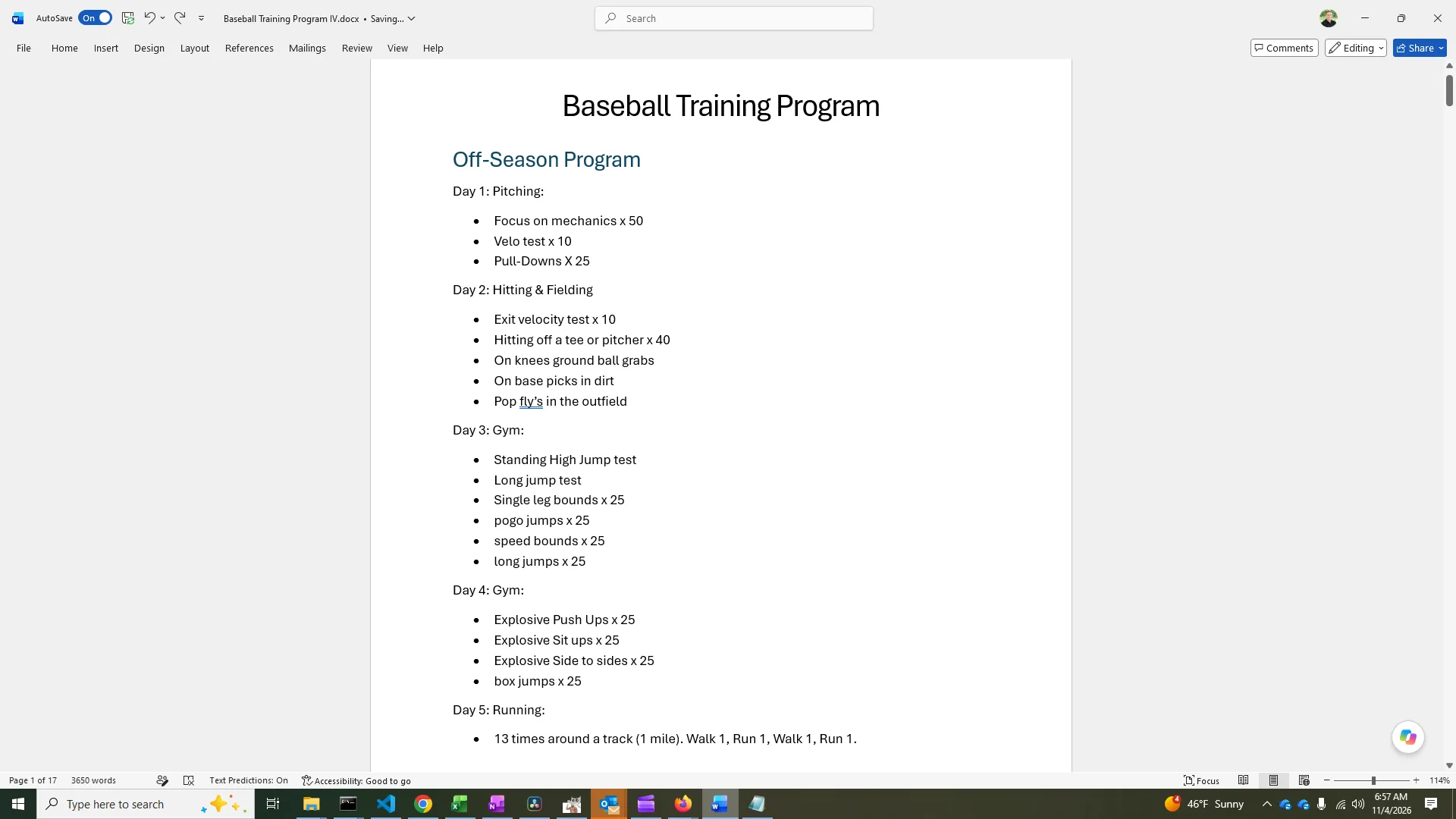
Off-Season Program
Day 1: Pitching:
- Focus on mechanics x 50
- Velo test x 10
- Pull-Downs X 25
Day 2: Hitting & Fielding
- Exit velocity test x 10
- Hitting off a tee or pitcher x 40
- On-knees ground ball grabs
- On-base picks in dirt
- Pop flies in the outfield
Day 3: Plyos (Gym):
- Standing High Jump test
- Long jump test
- Single-leg bounds x 25
- pogo jumps x 25
- speed bounds x 25
- long jumps x 25
Day 4: Explosive (Gym):
- Explosive Push-ups x 25
- Explosive sit-ups x 25
- Explosive side-to-sides x 25
- box jumps x 25
Day 5: Running (Gym):
- 13 times around a track (1 mile). Walk 1, Run 1, Walk 1, Run 1.
Baseball season is over, which means it's finally time to fix the stuff you can't touch when games matter.
The biggest project for my oldest son this winter isn't hitting. It isn't strength. It isn't some fancy velocity program we found on YouTube.
It's Pitching Mechanics
Honestly, his mechanics aren't great right now. I knew that during the season. I just wasn't willing to blow everything up in June and spend the next six weeks watching him miss the strike zone by three feet. Midseason isn't the time for rebuilding a delivery. Offseason is.
So we're starting from the ground up. Literally.
First comes the stride.
I'm going to measure out roughly 85% of his height and mark where that lead foot should land. Day one, that's the entire focus. Not velocity. Not command. Not breaking balls. Just getting him comfortable covering more ground with his lower half.
Then we move up the chain.
Hips.
Shoulders.
Hip-to-shoulder separation.
Getting that back knee moving.
Learning how to transfer energy instead of muscling the ball.
One thing I've learned is that kids usually can't fix three mechanical problems at once. Heck, most adults can't either. You give them one thought and let them own it.
Every Pitching Session Starts With A Velo Test
About ten pitches.
Throw as hard as you can.
I don't care where the ball goes.
The point isn't command. The point is tracking where his arm speed is that day. I've found that if velocity starts dropping for no obvious reason, something is usually off. Maybe he's tired. Maybe he's overthinking. Maybe we're doing too much.
Speaking of things that got renamed for no reason, we're also doing...
Pull-Downs.
When I was younger, we called them long toss.
Made perfect sense.
Now long toss apparently means launching moon balls halfway to another zip code, and pull-downs are the hard throws on a line. Whatever. Twenty-five reps and we're done.
That's another theme of this offseason.
Less.
A lot less.
Saturday & Sunday Are Our Hitting And Fielding Days
We'll test exit velocity because I want real feedback, not guesses. Last year I tried measuring from behind the hitter and got numbers all over the place. One swing would read 70. The next would read 50. Half the time I think the device was picking up the bat, not the ball.
This year I'll position it in front of the tee and see if we can get cleaner data.
My hitting philosophy with kids is pretty simple.
Practice fast. Play relaxed.
In batting practice and tee work, I want violent bat speed. Fast hands. Fast turns. Fast everything.
In games, I tell them to think about contact.
That's it.
Your swing takes care of the rest.
My boys hit plenty of line drives. They've hit the fence countless times. One has already put a ball over the wall. The power shows up naturally when the swing is efficient.
Fielding Gets A Lot Of Attention, Too
Knee-down ground balls.
Forehand work.
Backhand work.
Short hops.
For My Left-Handed Son, Lots Of First Base Picks
I'll start ten feet away throwing balls straight into the dirt. Once he's comfortable, I'll move farther back and make the hops tougher.
The skill that's probably getting the biggest offseason investment?
Pop flies.
They're not good at them.
There. I said it.
Ground balls? Fine.
Throws? Fine.
Pop flies? Adventure.
The first step is usually late. They drift instead of attacking the spot. Sometimes they run while staring over their shoulder, which rarely ends well.
So we're going to hit a ridiculous amount of fly balls this winter.
Then There's The Weight Room
Actually, not much of a weight room.
We spent a lot of the last year lifting. Squats. Strength work. Machines. Traditional strength-building stuff.
The boys got stronger.
No question.
What surprised me was how little of that strength showed up on the field.
That got me thinking.
Baseball isn't really a strength sport.
It's a speed sport disguised as a strength sport.
When people see Aaron Judge or Kyle Schwarber launching baseballs into another state, they assume the secret is brute force.
I don't think it is.
I think it's speed.
Bat speed.
Arm speed.
Hip speed.
The ability to transfer energy quickly.
That's Why We're Replacing A Lot Of Traditional Lifting With Explosive Work
High jump tests.
Broad jump tests.
Single-leg bounds.
Pogo jumps.
Speed bounds.
Long jumps.
We're tracking performance instead of simply accumulating reps.
The same idea shows up later in the week.
Explosive push-ups.
Explosive sit-ups.
Lateral jumps.
Box jumps.
Everything revolves around moving fast.
My oldest son is naturally methodical. That's one of the reasons he's good at strength training. He likes precision. He likes control.
Baseball asks for something different.
Baseball asks you to trust your training and fire.
Pitch.
Fire.
Swing.
Fire.
React.
Fire.
Sometimes the challenge isn't teaching a kid a new skill. Sometimes it's teaching him to stop thinking long enough to use the skills he already has.
The biggest change this offseason isn't a new drill or a new program.
It's a new philosophy.
For years, I thought more work meant more improvement.
More reps.
More throws.
More jumps.
More everything.
A few times we'd do hundreds of jumps. Hundreds of speed bag punches. Endless conditioning.
This winter we're trying something different.
Twenty-five great reps instead of 250 average ones.
One mile run instead of a marathon workout.
Mechanics instead of mindless volume.
Quality over quantity sounds cliché until you actually commit to it.
We'll see what happens.
Maybe I'm right.
Maybe I'm wrong.
That's the fun part of coaching your own kids. Every offseason is a little experiment.
And if we're lucky, by the time spring rolls around, they'll be moving faster, throwing harder, reading fly balls better, and most importantly, still excited to play baseball. That's a win long before the first pitch of the season.