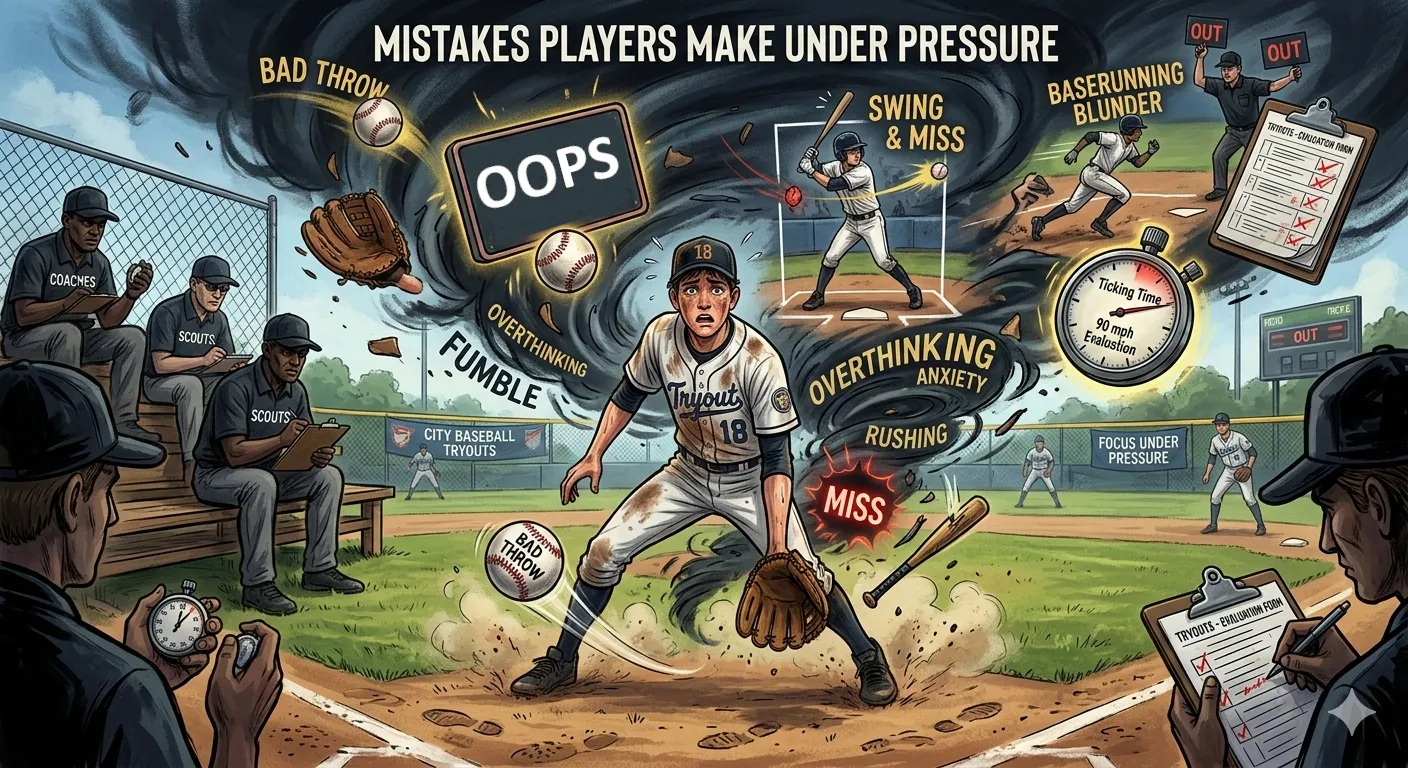
You can watch a kid at a tryout and almost read their thoughts by how stiff their shoulders get. It's like the moment someone says, “We’re evaluating you,” the body decides to melt into a pretzel. And honestly? It makes perfect sense. Baseball tryouts are one of the few places where you’re judged on tiny snapshots one swing, one throw, one bad hop that chooses the exact wrong moment to remind you physics has a sense of humor.
The Positive Coaching Alliance says confidence is the best competitive advantage in youth sports. The ironic twist is that tryouts are probably the single worst environment for building it.
But there is a way to get through it without feeling like your heart is trying to run the 60-yard dash before you do.
The Real Reason Tryouts Feel So Heavy
It’s not the coaches.
It’s not the drills.
It’s the story your mind tells you about what the tryout means.
A lot of players, especially younger ones, tie their identity to the outcome. “If I make the team, I’m good.” “If I don’t, something's wrong with me.” The APA calls this “evaluative threat,” and honestly, the term is perfect. Tryouts feel like your whole self is being judged, not just your glove work.
And when your brain thinks your identity is on the line?
It treats a ground ball like it’s a charging grizzly.
There’s also the parent thing. Let’s not pretend it doesn’t matter. When mom or dad is pacing behind the fence or giving That Look after a mistake, the pressure doubles. Even if they mean well. Especially when they mean well.
Then you add comparison, which is the silent killer of confidence. Watching a kid with a mustache and Exit Velo of Zeus take BP while you’re warming up? Yeah, your brain notices.
Confidence Isn’t a Personality Trait. It’s a Skill.
NCAA Baseball coaches say the most recruitable players are usually the ones who stay composed after something goes wrong. Not the most gifted. Not the loudest. The ones who can breathe, reset, and compete.
And that’s the good news: confidence isn’t magic. It’s not inherited. It’s something you train, just like footwork or arm strength.
The Stuff That Helps You Show Up Like Yourself Again
1. Shrink the tryout.
Not literally. But mentally.
When you treat it like a season-defining event, you’re toast.
When you treat it like a practice with strangers watching, your body goes, “Oh. We do this every day.”
One small mindset tweak:
“My job is not to impress them. My job is to compete.”
Competing is controllable. Impressing isn’t.
2. Your breath is your steering wheel. Use it.
Nothing fancy.
Try: inhale 4 seconds → exhale 6.
Long exhales, calm your system enough for your swing to return to normal human speed instead of panic speed.
You won’t magically feel “zen,” but you’ll feel enough to think clearly.
3. Have one cue. Just one.
Tryouts make people overthink.
Overthinking makes mechanics clunky.
Find the cue that brings you back:
- “Smooth”
- “See it”
- “Stay tall”
- “Quiet hands”
Pick one and ride it the whole day.
4. Watch the athlete who recovers best. Be that kid.
There’s always one player who boots a ball and just… shrugs.
Not in a jerk way; in a “next one” way.
Coaches trust those kids.
That reaction tells them you won’t unravel in the seventh inning of a close game.
If you need a quick reset: Dust your hands.
Tap your cleats.
Exhale.
Move again.
It doesn’t matter what it is. Consistency is the point.
5. Control the stuff before the tryout that no one talks about.
Pack your gear the night before.
Eat something simple.
Warm up a tiny bit longer than you think you need.
Don’t blast hype music like you’re entering a UFC fight, your nervous system is already cooking.
The most confident athletes look calm because they’re prepared, not fearless.
The Plot Twist
Once you accept that pressure is normal, not a flaw, not a sign you’re “not clutch”, it loses its teeth.
Tryouts feel stressful because you care.
Because you want the spot.
Because baseball actually means something to you.
And honestly?
That’s the part that makes athletes worth rooting for.
Confidence isn’t the absence of nerves.
Confidence is showing up even when your nerves are extremely dramatic.
You don’t have to be perfect at tryouts.
You just have to be yourself before your brain tries to rewrite the script.