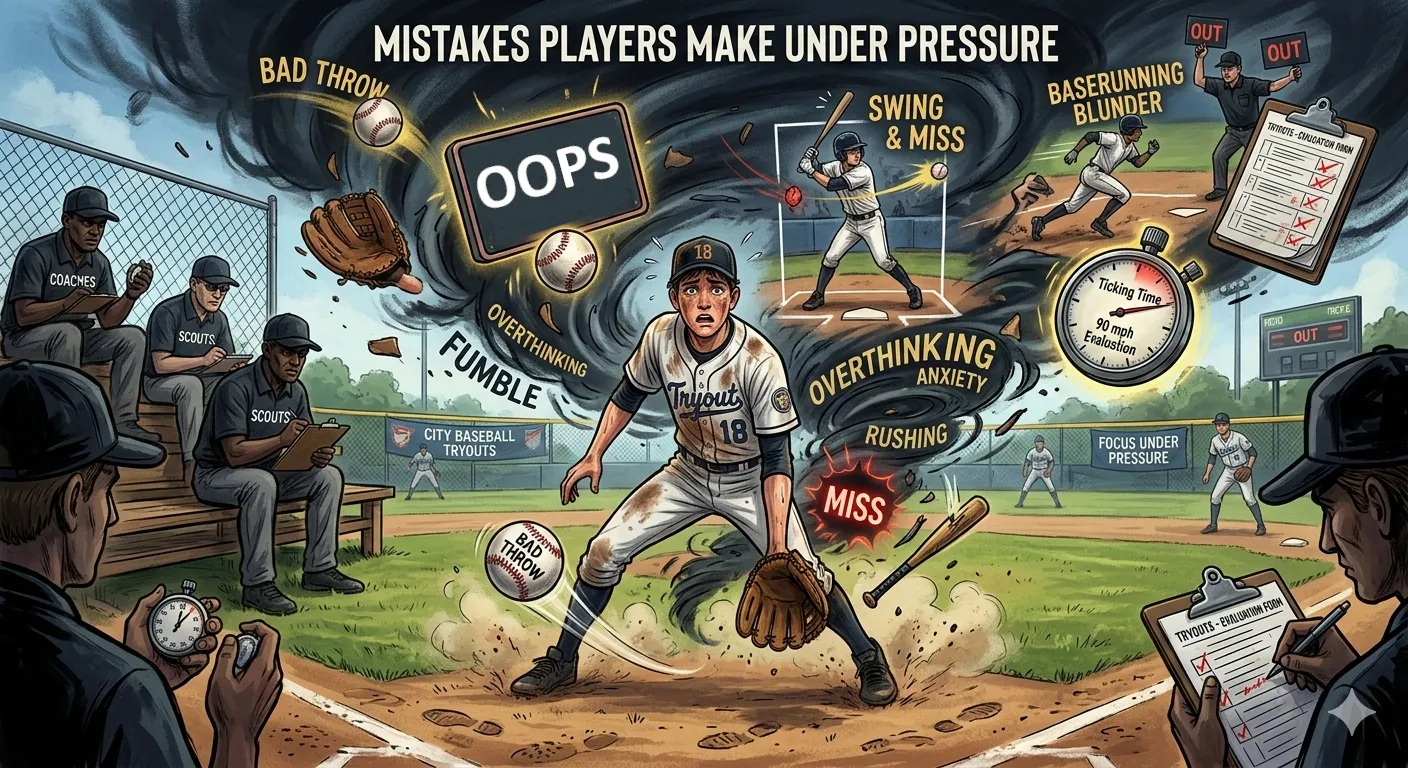
Let’s just start with the obvious: baseball tryouts mess with kids’ heads. Even the talented ones. Especially the talented ones. You can be smooth all winter, hitting in cages, lifting at places like Cressey Sports Performance, doing every drill Instagram can throw at you… Then one clipboard appears, and your nervous system suddenly forgets your name.
And honestly? You can almost predict it. The shoulders inch up. The stride gets choppy. The eyes dart toward the evaluators like they might steal your soul.
Mental toughness isn’t about turning kids into ice-cold Navy SEALs. It’s teaching them how to keep their brain from hijacking the moment. Ken Ravizza spent decades preaching this. AASP mental performance coaches still preach this. And every coach who’s been through one chaotic tryout knows: the mental game isn’t the extra, it’s the foundation.
So here’s the real stuff. The human stuff. The things players actually use when their heart rate spikes and the throw to first suddenly feels 200 feet longer than usual.
The Routine That Tells Your Brain: “We’ve Done This Before.”
Routines save kids from themselves. They shrink the unknown. Ravizza called it “your anchor.” Simple, repeatable, borderline boring because boring works when pressure doesn’t.
Here’s the rough shape of a routine that actually helps:
- The same warm-up. Not a perfect one. A familiar one.
- One check-in breath before each station. Not dramatic, just enough to get oxygen back in the conversation.
- One cue word you commit to. Something dumb-simple: “smooth,” “quiet,” “tall.”
- And a reset after mistakes. Brush the dirt. Touch your hat. Tap your cleats. Doesn’t matter. Consistency > cleverness.
Tryouts are chaotic. A routine is the only thing kids can drag into the chaos with them.
Breathing: The Most Ignored, Most Powerful Tool
I know. I know. Every coach says, “Just breathe.”
But most of them say it like breathing is some magical reset button. It’s not. It’s a steering wheel. You turn your nervous system one direction or the other with every inhale-exhale ratio.
A simple pattern kids actually remember:
Inhale for 4 → Exhale for 6.
That longer exhale signals “we’re safe.” Muscles loosen. Vision widens. Heart rate dips just enough that the swing stops feeling like a mechanical disaster.
You can get weird with breathwork later. But in a tryout? Keep it caveman simple. Long exhale = better brain.
Focus Drills That Give the Mind Something Productive to Do
Tryout anxiety is basically your brain screaming at you about things you can’t control. The trick is swapping the noise with a job.
A few examples I’ve seen work in real time:
• The “See One Thing” drill
Pick a tiny detail in front of you, a stitch, a blade of grass, the corner of the plate, and lock in for two seconds. It snaps the brain out of the what-if hamster wheel.
• The “One Cue Only” rule
Players who think of five mechanical adjustments at once melt like cheap ice cream. They get one cue. One. Anything more, and the brain gets greedy and ruins everything.
• The Ravizza-style Reset
Mistake → Exhale → Physical action → Back to the task.
No storytelling. No tantrum. No apology tour.
• The “Compete vs. Impress” reframing
Every mental performance coach I’ve spoken to (even the ones who avoid the spotlight) uses this. Impressing creates panic. Competing creates simplicity.
You can’t evaluate well in panic.
The Calm Kids Aren’t Calm
This part is important.
When you see a kid who looks unbothered, it’s not because their brain is some perfectly quiet lake. They’re just better at directing the chaos. They’ve practiced the routine. They’ve practiced breathing. They’ve practiced resetting.
It looks like confidence.
It’s actually management.
The Part People Miss Every Tryout Season
Mental toughness isn’t some warrior mentality. It isn’t growling. It isn’t pretending you don’t feel nervous. It’s accepting the nerves and working with them instead of against them.
Tryouts aren’t supposed to feel easy.
But they don’t have to feel like a freefall, either.
A solid routine.
A steady breath.
A simple cue.
A fast reset.
You stack those together, and suddenly, kids start looking like themselves again, right when they need it most.