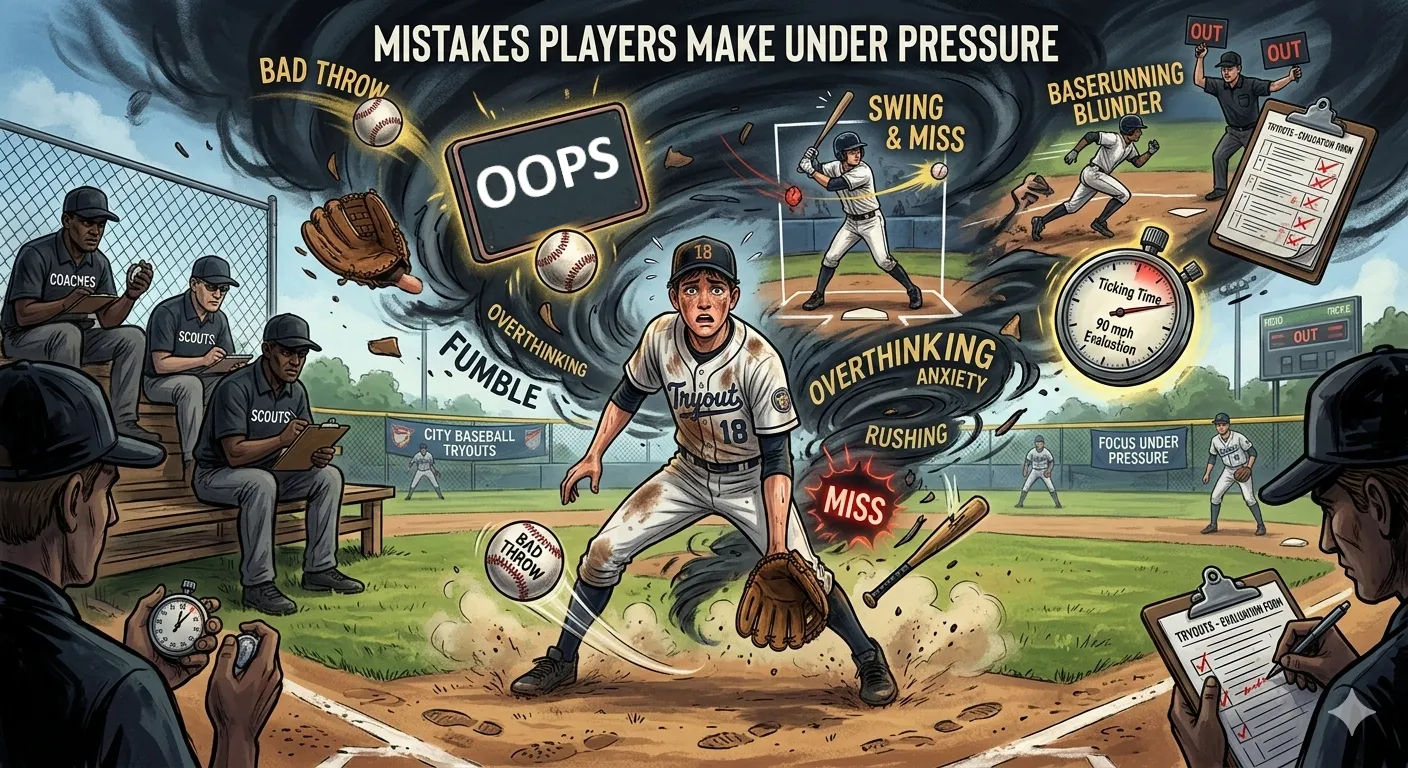
A few years ago, my son didn't make a baseball team.
At first, I reacted the way most parents do. I started replaying every moment of the tryout in my head, trying to figure out what went wrong.
The confusing part was that he wasn't completely outmatched.
He was tall. He could hit. He was a left-handed first baseman. In youth baseball, that's not exactly a common combination. I honestly thought he had a legitimate chance to make the team.
But he didn't.
The more I thought about it, the more one question kept bothering me:
Why?
Not "Why didn't my son make the team?"
But rather:
How do coaches actually decide who makes a team in the first place?
That question sent me down a rabbit hole I wasn't expecting.
The Problem With Youth Baseball Tryouts
Most youth baseball tryouts don't last very long.
A coach might have 40, 60, or even more players to evaluate in just a couple of hours.
Think about that for a second.
If you were handed 60 kids and told to build a roster in two hours, how would you do it?
It's not an easy problem.
As a coach, I'd want players with good attitudes.
I'd want players who can hit.
I'd want players who can field.
I'd want competitors. Kids who respond well to pressure. Kids who bounce back after mistakes. Kids who make the players around them better.
The problem is that tryouts don't really reveal those things.
You can't tell how a player reacts after striking out with the game on the line.
You can't tell whether that player is the emotional leader of the dugout.
You can't tell if he works harder than everyone else when nobody is watching.
You can't tell whether he folds under pressure or thrives in chaos.
Those qualities matter. In many cases, they matter more than anything else.
But they're largely invisible during a short tryout.
That realization led me to an uncomfortable conclusion:
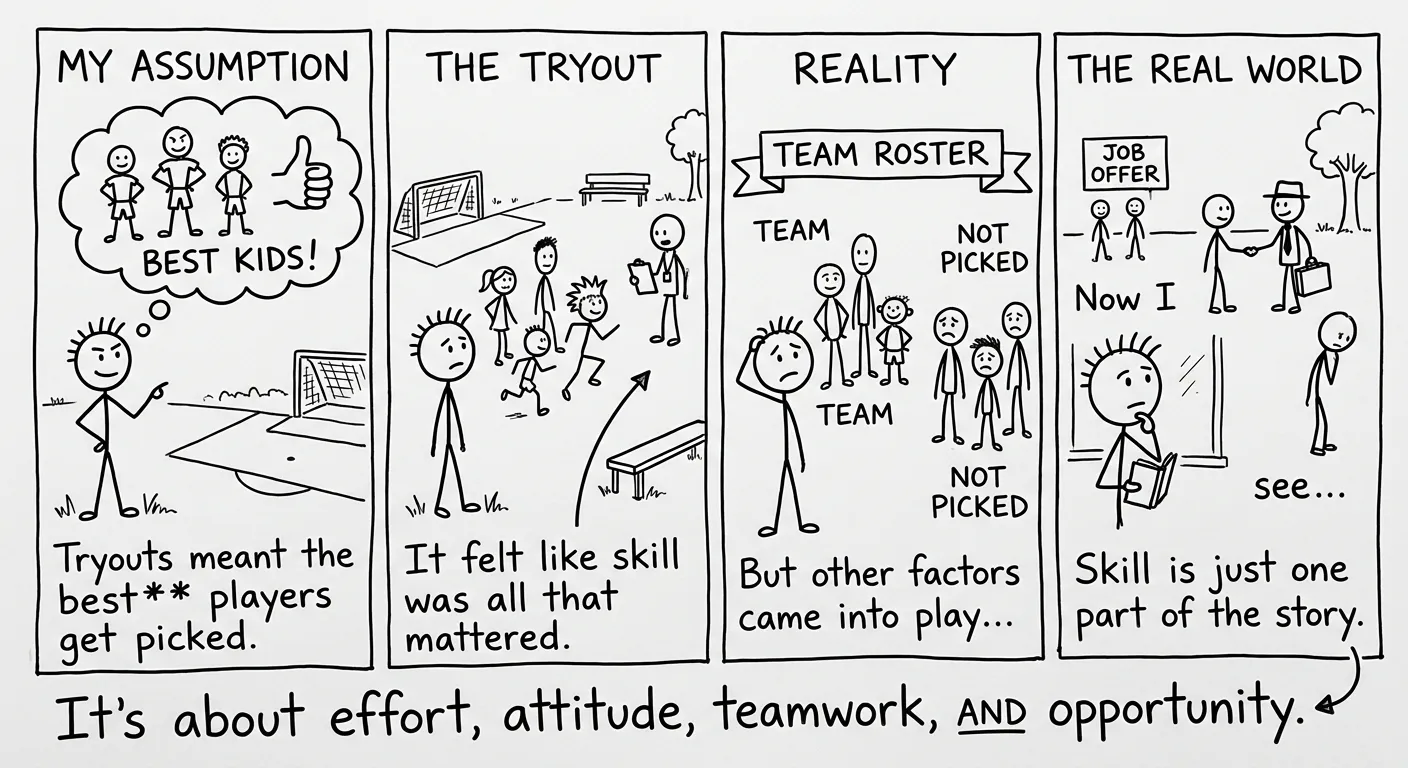
Tryouts aren't designed to identify the best player. They're designed to identify the best player that can be identified quickly.
Those are not always the same thing.
Why Coaches Make Fast Judgments
Before any coaches start sharpening their pitchforks, let me be clear.
I don't think coaches are doing anything wrong.
I think they're doing exactly what all humans do when they have limited information.
They make decisions based on what they can see.
That's not coaching.
That's psychology.
The truth is that when we don't have enough information, we rely on shortcuts.
Whether we're hiring employees, evaluating students, interviewing job candidates, or running a baseball tryout, we tend to favor people who immediately signal potential.
And that's when I started noticing something.
The players who seem to catch a coach's eye first often aren't the players with the most proven production.
They're the players who look athletic.
They run smoothly.
They move smoothly.
They throw smoothly.
Everything looks effortless.
The movements make sense.
Nothing appears forced.
Nothing appears awkward.
They simply look like athletes.
The Athletic Appearance Advantage
Imagine two players.
The first player looks awkward running. His movements aren't fluid. He doesn't immediately stand out physically.
The second player glides around the field. Everything looks coordinated and natural.
Now imagine the first player fields ten out of ten ground balls.
The second player fields eight out of ten.
Which player catches your eye first?
If we're being honest, most of us already know the answer.
And that's where I started getting uncomfortable.
Because I don't think I'd be immune to it either.
I wish I could confidently say I'd evaluate only the results.
I wish I could say I wouldn't be influenced by how a player moves.
But I honestly don't know if that's true.
Athleticism grabs your attention.
Performance often needs more time.
And tryouts rarely provide that time.
What Does Athletic Actually Mean?
That question became an obsession for me.
What exactly are we seeing when we look at a kid and immediately think:
"That kid is athletic."
Most of us can't explain it.
We just know it when we see it.
A player walks onto the field.
Takes a few warm-up swings.
Throws a baseball across the diamond.
And within ten seconds, many of us have already formed an opinion.
But what information are we actually using?
We're not measuring exit velocity.
We're not measuring baseball IQ.
We're not evaluating work ethic.
We're not evaluating competitiveness.
We're not evaluating game performance.
So what's left?
The more I thought about it, the more I started looking outside of baseball.
I started thinking about gymnasts.
Dancers.
Figure skaters.
Athletes who are universally described as athletic despite often having completely different body types from baseball players.
What do they all have in common?
Balance.
Coordination.
Body control.
Spatial awareness.
The ability to stop and start effortlessly.
The ability to create force quickly.
The ability to move without appearing to fight their own bodies.
And then it hit me.
Maybe when we call someone athletic, we're not talking about strength.
Maybe we're not talking about speed.
Maybe we're not even talking about sports performance.
Maybe we're talking about movement quality.
The Real Fear Parents Have
The longer I thought about this, the more I realized my concern wasn't actually athleticism itself.
My concern was opportunity.
What if some players are sending signals coaches interpret as potential before they ever have a chance to prove themselves?
What if coaches aren't choosing the wrong players?
What if they're choosing the players who are easiest to identify in a limited amount of time?
And what if those are two different things?
That's the thought I couldn't shake.
What if a kid isn't losing opportunities because he's not good enough?
What if he's losing opportunities because people never stick around long enough to discover how good he really is?
That's a very different problem.
Why Athletic Development Matters More Than I Thought
For years, I believed that if my boys could hit, throw, compete, and perform, everything else would sort itself out.
Now I'm not so sure.
Because before coaches understand a player's character...
Before they understand his work ethic...
Before they understand how he performs under pressure...
All they really have is what they can see.
If that's true, then athletic development becomes about more than sports performance.
It's about visibility.
It's about creating positive first impressions.
It's about helping a player demonstrate potential as quickly as possible.
That's a big reason why we're spending more time on athletic development now.
More balance work.
More coordination training.
More jumping.
More landing.
More movement skills.
Not because I want someone to call my boys athletic.
Honestly, I couldn't care less about that.
I care about giving them every opportunity possible.
And if becoming a better mover helps them earn a second look, then that's worth pursuing.
Because maybe athleticism isn't just about running faster or jumping higher.
Maybe athleticism is what gets a coach to look twice.
And sometimes that second look is all a kid needs.