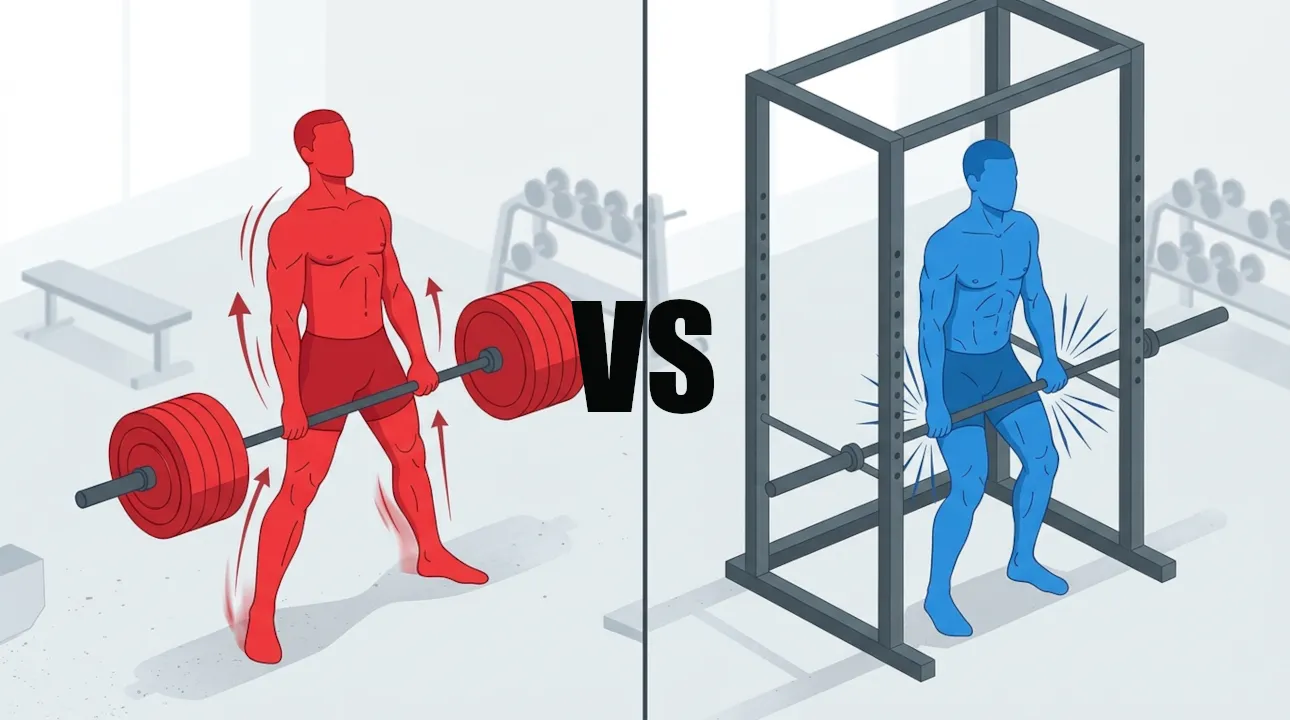
New research in the International Journal of Sports Physiology and Performance asked one question: Which's more important for explosive movement, isometric training or strength training?
The Main Finding
✅ Heavy strength training (squats, deadlifts, power cleans, etc.) was slightly better than isometric strength tests at predicting athletic performance.
The advantage was small, but consistent enough that the researchers believe traditional strength training should be the foundation for developing explosive athletes.
What Matters Most?
For jumping and explosive power:
- Heavy lifting strength was clearly more important.
- Stronger squatters generally jumped higher.
For agility and change of direction:
- Neither heavy lifting nor isometric testing was better.
- Both seemed equally useful.
For isometric peak force:
- It worked about as well as heavy lifting strength.
For isometric RFD (Rate of Force Development):
- It was much less useful than heavy lifting strength for predicting performance.
What This Means for Baseball
If you're training a baseball player, prioritize:
- Squat strength
- Trap-bar deadlift strength
- Power cleans or jump shrugs
- Single-leg strength work
- Jumping, sprinting, and throwing drills
Use isometrics as a supplement, not a replacement.
Biggest Takeaway
Get stronger first.
A player who raises their squat from 185 lbs to 315 lbs will likely see more improvement in explosive athletic performance than a player who only improves their isometric test scores.
For Parents
If your son wants to hit harder, throw harder, run faster, and become a better athlete:
Focus on building real strength through progressive resistance training. Isometrics are useful tools, but traditional strength training appears to be most strongly linked to the athletic qualities that matter most.
Abstract
To help athletes perform their best, coaches need to know which physical skills matter most. One way to do this is by looking at how closely a physical ability, like strength, is connected to athletic performance. If one ability has a stronger connection to success than another, it may be more important to test and train. This can help coaches choose the right exercises and improve performance faster.
Being able to move very fast is important in almost every sport. Athletes need speed and power to jump, sprint, hit, throw, and quickly change direction. Tests for jumping, running, and agility are often used to tell the difference between average athletes and top athletes. Because of this, it is important to learn which physical abilities help athletes move the fastest.
Many coaches believe that maximum strength is one of the most important abilities an athlete can have. Maximum strength is often tested by seeing how much weight a person can lift in exercises like the squat. Stronger athletes usually perform better in many sports and physical activities. However, these lifting tests are not the only way to measure strength.
Another way to test strength is with isometric exercises. In these tests, the athlete pushes or pulls as hard as possible without moving. Because there is no movement, the test is less affected by things like body shape, technique, or coordination. Athletes typically push or pull against an object for about five seconds, and the highest force they produce is recorded. Studies have shown that isometric strength is also related to jumping, sprinting, and changing direction quickly. However, it is not clear whether isometric strength or traditional weightlifting strength is more closely connected to fast athletic movements.
Isometric tests have another advantage. They can measure how quickly an athlete produces force during the first part of a movement. This is important because many sports movements happen very fast. For example, a runner's foot may only touch the ground for less than 150 milliseconds. Researchers have found that the ability to produce force quickly may help with sprinting, cycling, and jumping. Still, it is not known if these measurements are better predictors of performance than traditional strength tests.
Knowing which type of strength test is most closely related to fast movement can help coaches make better decisions. It can help them choose the best tests, save time, and focus training on the qualities that are most likely to improve performance.
Because of this, the researchers reviewed and combined the results of many studies. They wanted to find out whether traditional lower-body strength tests, such as heavy squats, or similar isometric strength tests had a stronger connection to fast athletic movements. They also looked at whether the type of movement or the type of isometric measurement changed the results.
How the Researchers Did the Study
Finding the Studies
In April 2025, the researchers searched for studies that compared different types of strength tests. They looked through three large sports and science databases and only included studies that were published in English and reviewed by other experts. Two researchers checked each study to decide if it should be included. They also looked at the reference lists of studies to find additional research. The study plan was recorded ahead of time so the process would be fair and transparent.
Choosing Which Studies to Include
The researchers only included studies that met all of these rules:
- They used an isometric strength test, such as an isometric mid-thigh pull or an isometric squat.
- They included a traditional strength test, such as a squat, deadlift, or power clean using heavy weights.
- They measured athletic movements that require speed and power, such as jumping, sprinting, changing direction, agility, or cycling.
- They reported how closely the strength tests were related to athletic performance.
- The participants were healthy adults or athletes.
- The study was published in a peer-reviewed journal before April 2025.
The researchers collected information about the athletes, the tests that were used, and the relationships between strength and performance.
What They Measured
For the isometric tests, the researchers looked at:
- Maximum force produced.
- How quickly force was produced.
- The amount of force produced during the first fractions of a second.
For the traditional strength tests, they looked at the heaviest weight athletes could lift in exercises such as:
- Squats
- Deadlifts
- Power cleans
For athletic performance, they looked at:
- Vertical jumps
- Sprint speed
- Change-of-direction ability
- Agility
When several jump measurements were available, the researchers focused on important results such as jump height and takeoff speed.
Checking Study Quality
The researchers scored each study to see how well it was designed and reported. Each study could receive up to 10 points. Higher scores meant the study methods were clearer and more reliable.
Analyzing the Results
The researchers combined the results from all of the studies using special statistics software. This allowed them to compare many different studies at once.
They wanted to answer one main question:
Which type of strength test has a stronger connection to fast athletic movements: traditional heavy lifting tests or isometric strength tests?
They also looked at whether the results changed based on:
- The type of athletic movement (jumping, sprinting, agility, etc.).
- The type of isometric measurement (maximum force or rate of force development).
- The type of isometric test (isometric squat or mid-thigh pull).
- The type of weightlifting test (squat or power clean).
What Studies Were Included?
The researchers started with 38 studies after removing duplicates. After reviewing them, only 7 studies met all the requirements and were included in the final analysis.
These studies included 299 people, but only 12 were women. Some participants were college students, while others were trained athletes such as basketball players, rugby players, field hockey players, and strength and power athletes.
Were the Studies Good Quality?
Yes. The studies scored between 7 and 9 out of 10 for quality, with an average score of just over 8 out of 10.
However, most studies did not use participants who represented the general population very well. This means the results may not apply equally to everyone.
What Tests Were Used?
Most studies used one of two isometric strength tests:
- Isometric Mid-Thigh Pull (IMTP), where athletes pull against an immovable bar.
- Isometric Squat, where athletes push against an immovable bar from a squat position.
Most heavy lifting tests used a 1-rep max squat, though a few used power cleans.
For athletic performance, the studies mostly measured:
- Countermovement jumps (CMJ)
- Squat jumps
- Vertical jumps
- Standing long jumps
- Drop jumps
- Agility tests
- Change-of-direction tests
Interestingly, none of the studies included sprinting tests that met the researchers' requirements.
What Did They Find?
Main Finding
Overall, heavy lifting strength tests were slightly better at predicting athletic performance than isometric strength tests.
The advantage was small, but it was statistically meaningful.
In simple terms:
Athletes who were stronger in exercises like squats and power cleans tended to perform slightly better in explosive athletic movements than athletes who scored highly on isometric strength tests.
Jumping Performance
When the researchers looked specifically at jumping tests, heavy lifting strength showed a stronger relationship.
This was especially true for:
- Countermovement jumps
- Squat jumps
- Vertical jumps
Takeaway: If your goal is to jump higher or produce more explosive power, traditional strength measures such as squat strength may tell you a little more than isometric tests.
Reactive Strength and Agility
For activities that require reacting quickly, such as:
- Drop jumps
- Rapid direction changes
- Agility drills
there was no clear winner.
Heavy lifting and isometric tests were about the same at explaining performance.
Takeaway: Both types of strength testing can provide useful information for these athletic skills.
Peak Force vs. Rate of Force Development (RFD)
This was one of the most interesting findings.
When researchers compared:
- Peak Force (how much force you can produce)
- Rate of Force Development (RFD) (how quickly you can produce force)
they found something surprising.
Using RFD from isometric tests was much worse at predicting performance than heavy lifting strength tests.
However, when using peak force, there was almost no difference between heavy lifting and isometric testing.
Simple translation:
How strong you are matters more than how quickly you produce force in these tests.
Isometric Squat vs. Mid-Thigh Pull
The researchers found no meaningful difference between:
- Isometric Squat
- Isometric Mid-Thigh Pull (IMTP)
Both tests had very similar relationships with athletic performance.
Takeaway: Coaches can likely use either test and get similar information.
Squat vs. Power Clean
When looking at different lifting exercises:
- Squats showed little advantage over isometric tests.
- Power cleans showed a larger advantage.
This suggests that explosive lifts like the power clean may be more closely related to fast athletic movements.
What This Means for Baseball
For a baseball player trying to improve:
- Bat speed
- Throwing velocity
- First-step quickness
- Jump performance
- Overall explosiveness
The study suggests that getting stronger in dynamic lifts like squats and power cleans may be slightly more important than improving isometric test scores alone.
The biggest practical lesson is:
Build real strength first.
If a player increases their squat from 185 lbs to 315 lbs while maintaining good movement quality, that increase will likely have more impact on athletic performance than simply improving their score on an isometric test.
For baseball specifically, this supports a training foundation built around:
- Squats
- Trap-bar deadlifts
- Power cleans or jump shrugs
- Split squats
- Explosive jumping and throwing drills
while using isometric tests mainly as a way to measure strength rather than as the primary training goal.
What Did the Researchers Learn?
The researchers wanted to find out whether heavy lifting strength tests or isometric strength tests were better at predicting fast athletic movements.
They looked at 7 studies involving 299 people.
Their main finding was:
Heavy lifting tests were slightly better at predicting athletic performance than isometric tests.
However, the advantage was small, and the results varied between studies. This means that one test is not always better than the other. The best choice may depend on the athlete and the sport.
Overall Findings
Both types of strength tests are useful.
- Heavy lifting tests (like squats and power cleans) can tell coaches a lot about an athlete's ability to move fast.
- Isometric tests (like the isometric squat and mid-thigh pull) can also provide valuable information.
The researchers believe these tests measure some of the same things, but they also measure different qualities.
For example:
A player may have:
- Great squat strength
- Average isometric strength
Or:
- Great isometric strength
- Average squat strength
Because of this, both tests can help coaches understand an athlete better.
Results for Jumping
Heavy lifting strength had a stronger relationship with:
- Countermovement jumps (CMJ)
- Squat jumps (SJ)
- Other explosive jumping tests
In other words:
Stronger athletes in exercises like squats and power cleans usually jumped higher.
The researchers think this happens because heavy lifts and jumping use many of the same skills:
- Coordinating multiple muscles
- Producing force while moving
- Using the stretch-shortening cycle (the elastic "bounce" muscles and tendons create)
These things happen in both jumping and lifting, but not as much in isometric tests.
Results for Reactive Strength and Agility
The results were different for:
- Drop jumps
- Agility drills
- Quick changes of direction
For these movements, neither test was clearly better.
The researchers think isometric strength may be more useful here because quick-reacting movements require:
- Strong tendons
- Stiff joints
- The ability to hold positions under force
These qualities may be measured better by isometric testing.
However, there were only a few studies on these skills, so more research is needed.
Peak Force vs. Rate of Force Development (RFD)
This was one of the most important findings.
Peak Force
When researchers compared:
- Maximum isometric force
- Maximum lifting strength
there was almost no difference.
Both explained athletic performance about equally well.
Rate of Force Development (RFD)
RFD measures how quickly force is produced.
The researchers expected RFD to be important because sports actions happen very fast.
Instead, they found:
Heavy lifting strength predicted performance much better than isometric RFD.
One reason may be that RFD measurements are noisy and inconsistent.
An athlete can get a very different RFD score from one test to the next, making it harder to find strong relationships.
Squat vs. Power Clean
The researchers also compared different lifting exercises.
Squat
The squat showed only a small advantage over isometric testing.
Power Clean
The power clean showed a much bigger advantage.
Why?
Because the power clean requires:
- Explosive force
- Speed
- Coordination
- Timing
These are also important in jumping and other athletic movements.
The researchers believe this is why power cleans were more closely related to athletic performance.
Limitations of the Study
The researchers pointed out several weaknesses:
Small Number of Studies
Only 7 studies met the requirements.
That means the conclusions are useful but not final.
Almost No Women Included
Out of 299 participants:
- 287 were men
- Only 12 were women
The results may not apply equally to female athletes.
No Sprint Studies
Surprisingly, no sprint-running studies met the requirements.
This means we still do not know whether heavy lifting or isometric strength is more closely related to sprint speed.
For baseball players, this is a big missing piece because sprinting matters for:
- Stealing bases
- Running out ground balls
- First-step quickness
- Outfield defense
Very Little Agility Research
Only a few studies examined:
- Agility
- Reactive strength
- Change of direction
More research is needed before drawing strong conclusions.
Practical Applications
The researchers do not recommend throwing out isometric testing.
Instead, they recommend using both methods.
Heavy lifting tests appear best for understanding:
- Jumping ability
- Explosive power
- Fast strength
Isometric tests may be especially useful for:
- Agility
- Reactive movements
- Joint-specific strength
- Monitoring athletes with lower injury risk
What This Means for Baseball
For baseball players trying to improve:
- Bat speed
- Throwing velocity
- Exit velocity
- Explosive power
The study suggests that building strength through exercises like:
- Squats
- Trap-bar deadlifts
- Power cleans
- Split squats
should be a major priority.
Isometric training and testing can still play a role, but they probably should not replace traditional strength training.
Source
James, L. P., Stutter, L. R., Lum, D., Huynh, M., & Talpey, S. W. (2026). Explaining High-Velocity Movement: Do Isometric or Heavy Strength Measures Show Stronger Associations? A Systematic Review and Meta-Analysis. International Journal of Sports Physiology and Performance, 21(11), 1222–1232. https://doi.org/10.1123/ijspp.2025-0623