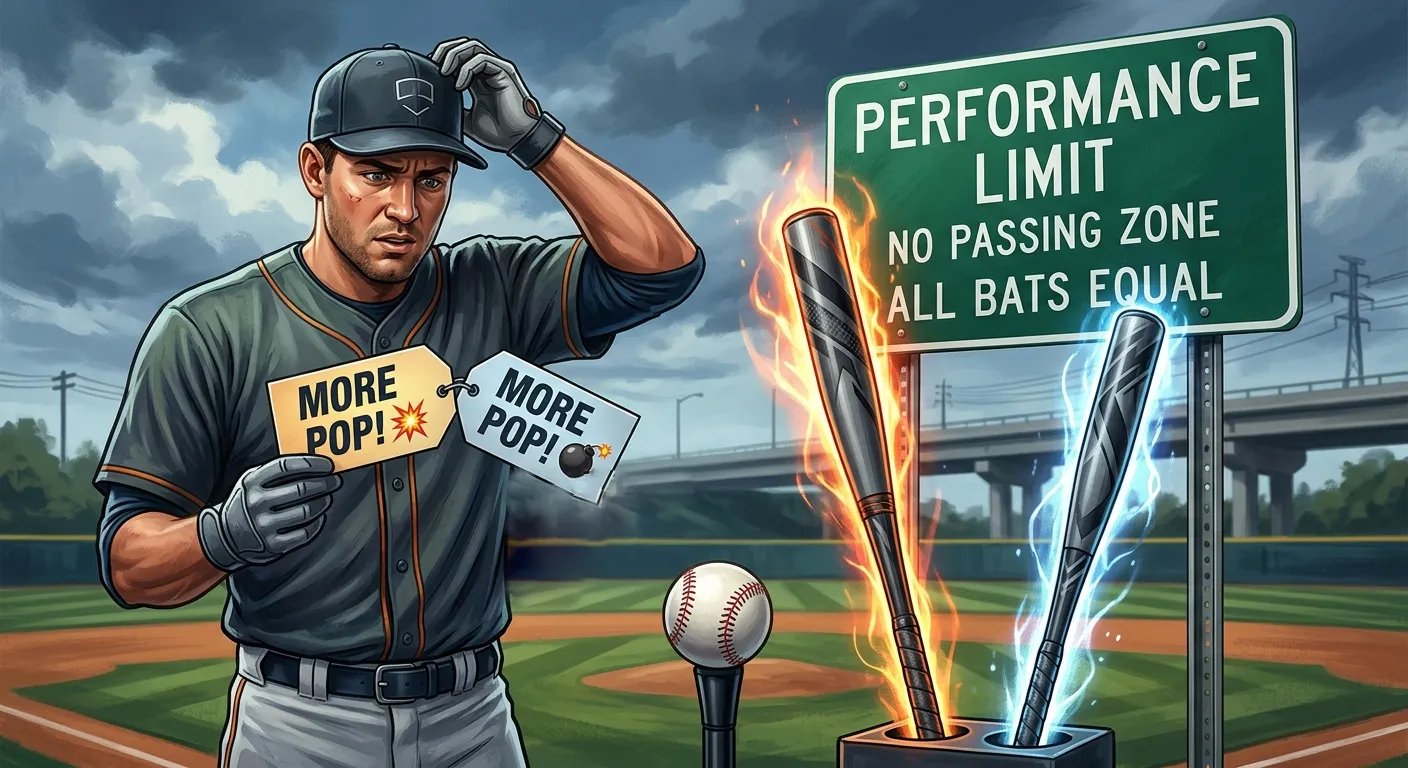
If every legal bat is forced through the same speed limit, why are players still shopping for “more pop”?
Picking a baseball bat based on "pop" is one of those ideas that sounds smart until you think about it for thirty seconds.
At least in regulated leagues.
That's the part people skip.
Walk into a sporting goods store, and you'll hear the same conversation over and over. Which bat has the most pop? Which one is hottest? Which one hits the ball farther?
The assumption hiding underneath all of those questions is that some legal bats are secretly launching missiles while others are basically pool noodles.
Not really.
Modern bat standards exist specifically to prevent that.
Whether it's BBCOR, USA Baseball, or another governing standard, the whole point is to cap performance. Manufacturers spend millions trying to get right up to the legal limit without crossing it. The result? Most top-tier certified bats cluster surprisingly close together in actual performance.
Not identical. Close.
Close enough that a player's swing is usually the bigger variable by a mile.
I've seen players obsess over bat reviews, comparing exit velocity differences that amount to maybe one mile per hour in controlled testing. Then they grab a bat that's an inch too long, too heavy, or feels awful in their hands.
Congratulations. You just sacrificed consistency for a marketing claim.
The irony is that the things that actually matter aren't as exciting to talk about.
How does the bat feel through the zone?
Can you control the barrel?
Do you swing it confidently?
Does the weight distribution match your swing?
Can you get the barrel out on an inside fastball?
Those questions matter every single at-bat. The mythical extra "pop" usually doesn't.
Of course, there are exceptions. If you're comparing bats from different standards, old non-compliant models, or damaged equipment, performance can vary significantly. But when you're comparing two legal, high-quality bats built for the same certification? You're shopping inside a very small window.
It's a little like buying a race car in a series where the engine output is tightly regulated. Every team is chasing tiny edges, but the driver still determines most of the outcome.
That's why the best hitters often look good with almost anything.
They aren't finding magic bats. They're finding bats that let them be themselves.
The uncomfortable truth is that many players search for equipment solutions to skill problems. A new bat feels easier than improving swing mechanics, bat speed, timing, or pitch recognition. I get it. Everyone loves gear.
I love gear.
But if you're choosing between two legal bats, stop asking which has the most pop. Start asking which one helps you deliver the barrel more often.
More barrels beat more hype.
Every time.
Why This Take Matters
The mistake is confusing regulated performance with player performance. Bat standards are designed to limit equipment advantages, so fit, feel, swing weight, and confidence usually matter far more than chasing tiny differences in advertised "pop." The argument isn't that bats are identical. It's that hitters often overestimate the bat and underestimate themselves.