The Legend vs. The Man Behind the Myth
Few athletes have ever escaped their own mythology. Babe Ruth certainly didn't.
Over the decades, George Herman Ruth transformed from a baseball player into something closer to American folklore. Stories about him got bigger, cleaner, and more dramatic with every retelling. He pointed to center field before a home run. He grew up as an orphan. He was just a big guy who swung hard. The Red Sox immediately suffered a supernatural curse the moment they sold him.
The problem is that history tends to get flattened when legends take over. Ruth's actual life was messier, stranger, and far more human than the myths suggest.
Let's separate the Bambino from the tall tales.
Myth 1: The 1932 World Series "Called Shot"
The most famous moment in baseball history might also be the most disputed.
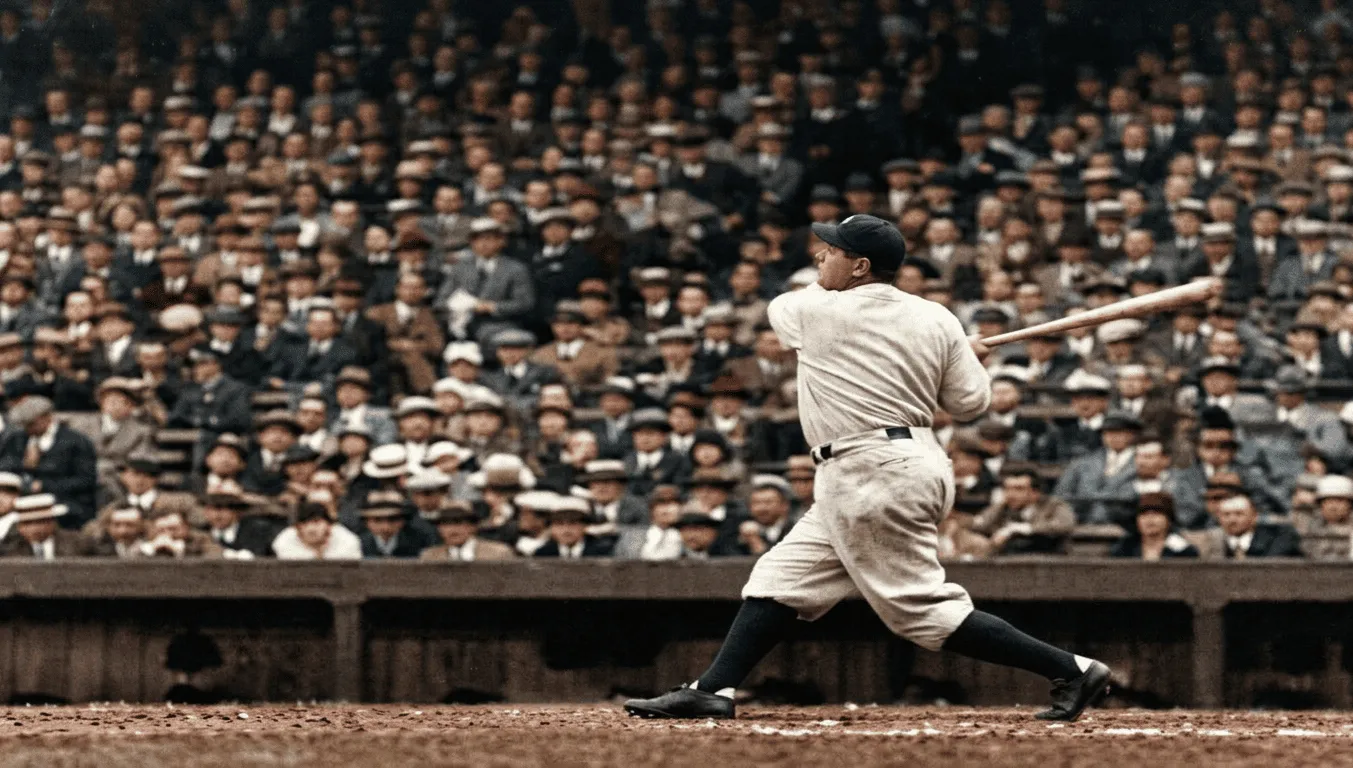
In Game 3 of the 1932 World Series, Babe Ruth stepped to the plate at Chicago's Wrigley Field. Accounts agree on what happened next: he hit a towering home run to deep center field.
What people still argue about is whether he predicted it.
The Evidence for and Against Pointing to Center Field
The legendary version is simple. Ruth points dramatically toward center field, essentially announcing where he's about to hit the ball. Moments later, he does exactly that.
Great story. Maybe too great.
Film footage exists, but it isn't definitive. Depending on where you stand, the footage either shows Ruth pointing toward center field or gesturing toward the Cubs' dugout while exchanging insults with players and fans. Some eyewitnesses swore he called his shot. Others who stood only yards away insisted he never did.
Even several decades later, participants couldn't agree on what they saw.
My take? Ruth probably knew how to put on a show. He was baseball's first true celebrity and understood spectacle better than almost anyone. Whether he literally predicted the home run is impossible to prove. What is beyond debate is that the ambiguity helped create one of sports' greatest stories.
The uncertainty is part of what keeps the myth alive.
Myth 2: Raised as an Orphan at St. Mary's
People often describe Babe Ruth as an orphan who grew up in a religious institution.
That's not what happened.
The Real Reason His Parents Sent Him Away
Ruth's parents were alive when he was sent away as a young child. They operated businesses in Baltimore and struggled to manage an energetic, often unruly son.
By nearly every account, young George was difficult to supervise. He skipped school, got into trouble, and spent much of his time roaming the streets. Eventually, his parents declared him incorrigible and placed him at St. Mary's Industrial School for Boys at age seven.
That sounds harsh through a modern lens, but it wasn't unusual for the era.
St. Mary's functioned as part school, part vocational institution, and part reform school. Ruth spent much of his youth there under the guidance of Brother Matthias, who became one of the most influential figures in his life.
The orphan narrative survives because it creates a cleaner story: abandoned boy becomes sports legend. Reality is less dramatic but more revealing. Ruth wasn't an orphan. He was a challenging kid whose family made a difficult decision they believed was necessary.
Myth 3: The Curse of the Bambino Was Immediate
The Red Sox sold Babe Ruth to the Yankees after the 1919 season. Decades later, fans framed the transaction as the beginning of a supernatural curse.
It's a fantastic sports myth.
It's also much more complicated than that.
The Financial Realities of the 1919 Sale to the Yankees
The popular version suggests Boston ownership foolishly dumped the greatest player in baseball and instantly paid the price.
The timeline doesn't really cooperate.
When owner Harry Frazee sold Ruth to New York, money was certainly a major factor. Frazee faced financial pressures and believed the sale would help stabilize his situation. But the deal wasn't viewed at the time as an obviously catastrophic mistake on the level people imagine today.
Remember, Ruth was still redefining baseball itself. Nobody had ever seen offensive power like his. Even supporters couldn't fully predict what he would become in the 1920s.
While Boston sank into an immediate and prolonged competitive drought following the trade—finishing in or near last place for much of the 1920s—the narrative of a supernatural "curse" was not created at the time. The mythology largely developed decades later as the championship drought stretched from years into generations.
Fans are storytellers. Once enough time passed, coincidence began to look like destiny.
Myth 4: He Was Out of Shape and Won Games Purely on Raw Strength
This one is probably my least favorite.
People see old photographs of Ruth late in his career and assume he succeeded because he was simply bigger and stronger than everyone else.
That dramatically understates what made him great.
Athleticism, Hand-Eye Coordination, and Reaction Time
Yes, Ruth carried extra weight during parts of his career.
He was also an extraordinary athlete.
Before becoming baseball's greatest slugger, he was an elite pitcher. You don't become one of the best left-handed pitchers in the major leagues through brute force alone. That requires coordination, balance, stamina, and precision.
Contemporaries regularly commented on Ruth's reflexes and hand-eye coordination. Those traits rarely show up in old black-and-white photographs, but they matter far more than body shape.
Modern athletes train year-round with nutritionists, video analysis, and strength coaches. Ruth had none of that. Judging him by today's physical standards misses the point.
Relative to his peers, he was remarkably athletic.
His power was merely the most visible part of a much larger skill set.
Myth 5: His 1930 Salary "Higher Than the President" Was a Scandal
In 1930, Babe Ruth signed a contract paying him $80,000 per year.
When reporters noted that President Herbert Hoover earned $75,000, Ruth supposedly responded: "I had a better year than he did."
It's one of the most quoted lines in sports history.
The quote may be embellished, but the broader story has also been distorted.
Why the Salary Wasn't Really a Scandal
People often treat Ruth's salary as evidence that America was shocked by athlete compensation.
Not exactly.
There was certainly discussion. The country was entering the Great Depression, and $80,000 was an eye-popping amount of money. Yet Ruth wasn't just another athlete. He was arguably the biggest box-office attraction in the nation.
Fans paid to see him.
Newspapers sold papers because of him.
Stadiums filled because of him.
In modern terms, Ruth wasn't merely a player. He was the sport's most valuable entertainment property.
The salary made headlines precisely because he generated headlines. That's different from a true public scandal.
In fact, the story says as much about Ruth's unmatched celebrity status as it does about his paycheck.
Why the True Story Is Better Than the Legend
The funny thing about Babe Ruth myths is that they often shrink him instead of elevating him.
The "called shot" myth turns a complex, charismatic showman into a cartoon hero. The orphan story erases the difficult realities of his upbringing. The idea that he succeeded on strength alone ignores extraordinary athletic gifts. The Curse of the Bambino simplifies decades of baseball history into a ghost story.
What remains after the myths are stripped away is a far more compelling figure.
Babe Ruth wasn't a folk tale. He was a flawed, talented, unpredictable human being who changed baseball forever. And honestly, that's a lot more impressive than any legend people invented afterward.