Most legends leave behind a technique everyone wants to copy. Babe Ruth left behind one nobody could quite explain.
If you look at old photos of Babe Ruth, your first reaction might be surprise. The stance doesn't look modern. It isn't balanced in the way coaches teach today. It doesn't resemble the textbook positions you see in Major League Baseball broadcasts. Yet somehow, from that unusual setup came one of the most devastating swings the sport has ever witnessed.
That's the mystery of Babe Ruth's batting stance. It looked imperfect. It looked unconventional. And it produced numbers so absurd that nearly a century later they're still difficult to comprehend.
To understand Ruth's stance, you have to stop thinking about baseball mechanics as a set of rigid rules. The Sultan of Swat played in an era before high-speed cameras, launch-angle discussions, biomechanics labs, and data-driven hitting coaches. What he possessed instead was something far less measurable and arguably more valuable: extraordinary feel.
When Ruth stepped into the batter's box, he immediately created a visual presence. Pitchers didn't just see a hitter. They saw a threat. His confidence seemed to occupy half the field before the ball was even thrown.
One of the most recognizable features of Ruth's stance was how open it appeared. He often stood with his front foot slightly pulled away from the plate, allowing his body to face the pitcher more directly than many hitters of his era. This positioning gave him a clear, uninterrupted view of the incoming pitch.
Today, some hitters still use a variant of this approach. Opening the stance can help with pitch recognition, especially against high-velocity pitching. Ruth wasn't doing it because some analyst handed him a report. He was doing it because it felt right and allowed him to see the baseball better.
The hands were another interesting element.
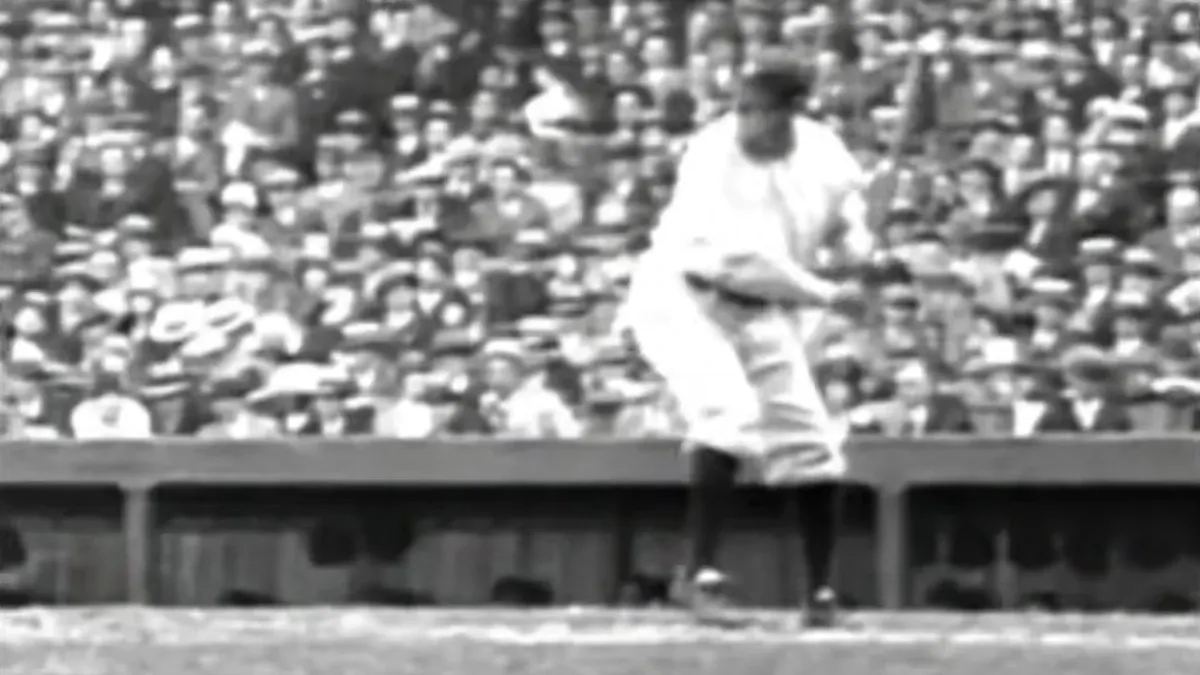
Photographs and surviving film show Ruth carrying the bat relatively high. The barrel sometimes pointed upward at an angle behind his head. There wasn't always perfect consistency from at-bat to at-bat, which is actually one of the most revealing details. Modern fans often imagine legendary hitters as precise mechanical machines. Ruth was more fluid. More athletic. He adjusted naturally.
His grip looked relaxed rather than rigid. That matters.
Great hitters frequently describe the swing as a whip rather than a push. Tension slows things down. Relaxation creates speed. Ruth's hands appeared loose until the instant they needed to explode through the strike zone.
And explode they did.
The thing people often misunderstand about Ruth is that his power wasn't solely the result of his size. Yes, he was physically imposing for his time. During much of his career he weighed over 200 pounds, making him significantly larger than many of his opponents.
But plenty of large players have existed throughout baseball history.
Very few became Babe Ruth.
The magic was in how effectively he transferred energy through his body. His stance positioned him to load weight onto his back side before unleashing a remarkably violent rotational movement. Even grainy black-and-white footage reveals how aggressively his hips and torso fired through contact.
Watch enough clips and a pattern emerges.
Ruth wasn't trying to make contact.
He was trying to do damage.
That sounds obvious today. Modern baseball embraces power hitting more than ever. In Ruth's era, however, this mindset was revolutionary.
Early twentieth-century baseball was dominated by what historians call the "dead-ball era." Teams focused on bunting, stealing bases, hit-and-run plays, and manufacturing runs one small step at a time. Home runs were relatively rare events.
Then Ruth arrived and started swinging as if the entire philosophy of the sport was wrong.
The stance was part of that revolution.
Everything in his setup seemed designed to create maximum force. His posture wasn't especially upright. There was often a slight athletic bend in the knees. His weight remained engaged and ready to move. Rather than appearing static, he looked coiled.
A spring is probably the best comparison.
At rest, it doesn't seem remarkable.
Then suddenly it releases.
One fascinating detail is that Ruth employed a noticeable stride. As the pitcher delivered the ball, Ruth would move his front foot forward to help generate momentum. Some modern hitters use larger leg kicks, while others prefer minimal movement. Ruth generally fell somewhere in the middle.
The stride accomplished two important things.
First, it helped synchronize his body.
Second, it added energy.
Timing and power are connected more closely than most casual fans realize. The stride wasn't merely decoration. It was part of a chain reaction. Weight shift led to hip rotation. Hip rotation drove the torso. The torso accelerated the arms. The arms delivered the barrel.
By the time the bat reached the baseball, an entire sequence had unfolded.
The result was historic.
Ruth hit 714 career home runs. The National Baseball Hall of Fame and Museum - Babe Ruth Biography
That number alone is incredible. What's even more incredible is considering the context.
When Ruth retired after the 1935 season, the player with the second-highest home run total wasn't remotely close. His advantage over much of the league resembled the gap between a Formula One car and ordinary traffic.
In 1927, Ruth hit 60 home runs.
For decades, that wasn't just a record. It felt untouchable.
Many statistical accomplishments eventually get surpassed because the sport evolves. Ruth's achievements often seemed immune to time itself.
Part of that dominance stemmed from the mindset reflected in his stance.
The batting stance is a physical expression of intention. Some hitters communicate caution. Some communicate patience. Some communicate adaptability.
Ruth communicated aggression.
Not recklessness. Aggression.
There's a difference.
He wasn't blindly swinging at every pitch. His career on-base percentage of .474, according to MLB.com, remains among the highest in baseball history. He drew enormous numbers of walks because pitchers feared challenging him.
Think about how absurd that is.
A player known primarily for home runs was also one of the greatest plate-discipline hitters ever.
His stance embodied that balance. He looked ready to attack, but he also remained comfortable waiting for a pitch he could drive.
Another frequently overlooked aspect is balance after contact.
In hitting instruction today, coaches often discuss maintaining posture through the swing. Ruth's violence didn't come at the expense of control. Despite generating extraordinary bat speed, he generally stayed centered enough to complete the motion effectively.
This is one reason why simply copying his stance wouldn't magically transform another hitter into Babe Ruth.
The visible setup is only part of the equation.
A batting stance is like the cover of a book. What matters most happens inside.
Thousands of young players have imitated the stances of stars. Very few have reproduced the underlying athletic qualities that made those stances work.
Ruth possessed exceptional hand-eye coordination. He possessed unusual strength. He possessed elite timing. Most importantly, he trusted his swing completely.
That last point deserves emphasis.
Watch old footage and you notice something rare.
Commitment.
Ruth didn't look hesitant.
Great hitters often reach a point where doubt disappears during the swing itself. Decisions happen before the pitch arrives. Once they commit, they unleash everything.
Ruth's stance seems to reflect that mentality. There is little visual evidence of caution. He appears prepared to attack from the moment he plants his feet.
Interestingly, some modern scouts might criticize elements of his setup if they encountered it in a high school showcase. The hands might seem unconventional. The movement patterns might not fit current teaching trends. Certain mechanics would likely be adjusted.
Yet that's exactly what makes studying legendary athletes so valuable.
Results matter.
The history of sports is filled with individuals who succeeded by violating accepted wisdom.
Muhammad Ali dropped his hands.
Jim Furyk built a Hall of Fame golf career with a swing that looked completely different from textbook instruction.
Babe Ruth's batting stance belongs in that same category.
Unusual. Effective. Impossible to ignore.
Another reason the stance worked was that it matched his personality.
This is something coaches sometimes underestimate.
The best athletic techniques are often personal rather than universal.
Ruth wasn't a quiet, restrained figure. He was larger than life. Crowds followed him everywhere. Newspapers chronicled his exploits. Fans packed stadiums hoping to witness something extraordinary.
His stance mirrored that theatrical presence.
When Ruth stepped into the box, there was a sense that something dramatic could happen.
And often it did.
Pitchers lived with a constant dilemma. Attack him and risk a home run. Avoid him and risk a walk. Neither option felt particularly appealing.
The stance became part of the psychological battle.
Every pitcher knew what Ruth wanted.
They just couldn't stop him often enough.
As baseball evolved, many elements of hitting instruction became more sophisticated. Coaches learned more about swing planes, kinetic sequencing, vision training, and bat paths. Technology revealed details invisible to previous generations.
Yet some truths remain unchanged.
Hitters still need balance.
They still need timing.
They still need confidence.
They still need a stance that allows them to see the ball and unleash their best swing.
In that sense, Ruth's approach remains surprisingly modern.
Not because young players should copy every detail.
They shouldn't.
But because Ruth understood a timeless principle: a batting stance exists to serve the hitter, not the other way around.
Too many athletes spend their careers searching for perfect mechanics. Ruth seemed more interested in finding mechanics that allowed him to be himself.
That distinction matters.
What worked for Babe Ruth worked because it amplified Babe Ruth.
The lasting image isn't merely a collection of technical positions. It's a powerful athlete standing in the box, bat raised, weight loaded, eyes locked on the pitcher, radiating confidence before the ball has even left the hand.
Every day, baseball searched for safer, smaller ways to score runs. Then Babe Ruth stepped into the batter's box. Because of that, pitchers changed their strategies. Because of that, teams changed how they built rosters. Because of that, fans began expecting home runs rather than treating them as miracles. Until finally, an entire sport transformed around the example of one hitter.
And it all started with a stance that looked a little strange, a little unpolished, and a lot more dangerous than anyone realized.