A towering pop-up looks harmless from the stands. Fans lean back, wait a few seconds, and expect the defense to make the catch. Coaches know better.
Few plays create more confusion than a baseball disappearing into the sky. Wind pushes it. The sun blinds fielders. Players sprint from different directions. Voices overlap. What should be an easy out can suddenly become a dropped ball, a collision, or an extra-base hit.
That's why every successful baseball team relies on a defensive hierarchy known as Pop-Up Priority.
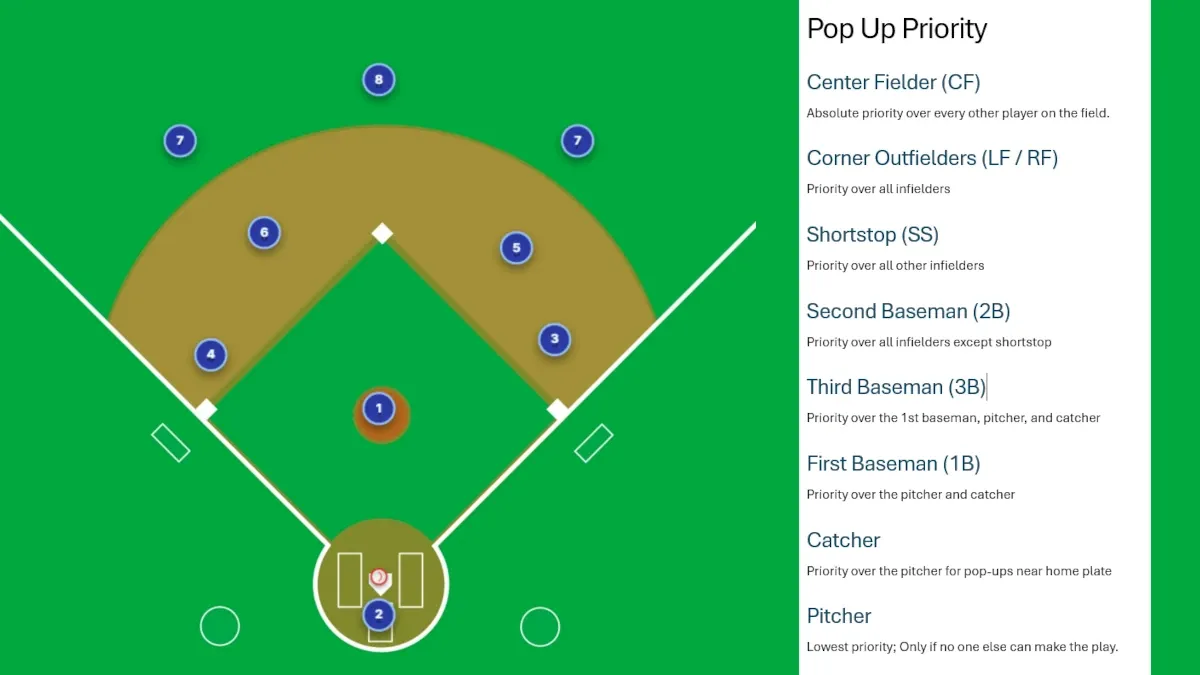
The principle is simple: when multiple defenders can potentially make a play, one player has priority over the others. Everyone on the field should know that hierarchy before the game starts. There should be no debate, no hesitation, and no split-second negotiation.
The standard defensive priority system looks like this:
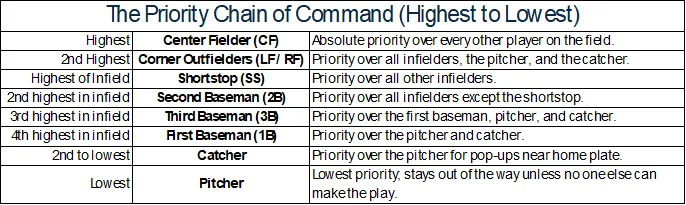
Center Fielder → Left Fielder & Right Fielder → Shortstop → Second Baseman → Third Baseman & First Baseman → Catcher → Pitcher
While every coach teaches the concept a little differently, this hierarchy exists because certain players typically have better angles, better vision, and safer paths to the baseball.
Let's break down exactly how it works and why it matters so much.
What Does "Pop Out" Mean in Baseball?
A pop-up occurs when a batter hits a ball high into the air and a defensive player catches it before it touches the ground.
Unlike a line drive, which travels on a relatively direct path, a pop-up climbs steeply into the sky. Some stay near the infield. Others drift into shallow outfield territory where multiple fielders may converge.
Officially, a pop out is simply a fly ball that results in an out. However, players and coaches usually use the term "pop-up" to describe high-arcing balls that remain in the air long enough to create decision-making challenges for the defense.
These plays test communication more than athletic ability.
A routine ground ball requires quick reactions. A pop-up requires trust.
The defense must instantly answer several questions:
- Who has the best angle?
- Who can see the ball most clearly?
- Which player is moving forward versus backward?
- Is anybody at risk of collision?
- Who has priority?
Teams that answer those questions automatically convert easy outs.
Teams that don't often hand opponents extra baserunners.
What Is Pop-Up Priority?
Pop-Up Priority is the predetermined hierarchy that determines which fielder has the right to make a catch when two or more defenders converge on the same fly ball.
Think of it as right-of-way rules on a highway.
Drivers don't stop at an intersection and negotiate who goes first. Everyone follows a known system.
Defensive baseball works the same way.
If a center fielder and right fielder are both approaching the same fly ball, the center fielder takes charge.
If a shortstop and second baseman can reach an infield pop-up, the shortstop generally has priority.
If a first baseman and pitcher both want the ball, the first baseman takes it.
The hierarchy removes uncertainty. Players are expected to yield immediately when a higher-priority defender calls for the baseball.
The standard hierarchy is:
- Center Fielder
- Left Fielder / Right Fielder
- Shortstop
- Second Baseman
- Third Baseman / First Baseman
- Catcher
- Pitcher
When the player with priority calls for the ball loudly and decisively, the other players must get out of the way.
Not eventually.
Immediately.
That split-second commitment is what makes the system work.
Why Pop-Up Priority Is Important
Most defensive mistakes on pop flies don't happen because someone lacks skill.
They happen because nobody takes control.
The consequences can be surprisingly severe.
Dropped Fly Balls
The most obvious result is a routine out turning into a baserunner.
At youth levels, this happens all the time. At higher levels, it still occurs when communication breaks down.
Field Collisions
These are far more dangerous.
Imagine a shortstop sprinting backward while staring into the sky. At the same time, a center fielder is charging forward at full speed.
Neither player is watching the other.
Without a clear priority system, two athletes can collide with tremendous force.
That's why coaches preach hierarchy relentlessly.
The goal isn't just making catches.
It's keeping everyone healthy.
Defensive Hesitation
The worst sound in baseball might not be a collision.
It might be silence.
When nobody calls the ball, hesitation creeps in. Fielders slow down. Confidence disappears. What should have been routine turns into chaos.
Clear priority creates aggressive play.
Aggressive play creates outs.
Master Outfield Communication with Center Field Hierarchy Rules
There is a reason the center fielder sits on top of every defensive priority chart.
The center fielder owns the largest defensive territory on the field.
More importantly, the center fielder usually has the best visual advantage.
When approaching a fly ball, the center fielder often runs forward or laterally while maintaining vision of both the baseball and surrounding fielders.
Corner outfielders frequently approach from the side.
That difference matters.
Why Center Field Has Highest Priority
Several factors give center fielders the edge:
- Superior field visibility
- Better reading angle
- Greater field coverage responsibility
- Easier communication with both corners
- Reduced collision risk
When a center fielder calls:
"BALL!" "I GOT IT!" "MINE!"
The discussion ends.
Everyone else yields.
Not because the center fielder is necessarily the best athlete, but because the defense functions best when one clear authority exists.
The Gap Rule
Balls hit between outfielders often create uncertainty.
Elite defenses remove that uncertainty through center field priority.
A ball drifting toward left-center or right-center belongs to the center fielder whenever he can reasonably make the play.
This allows corner outfielders to shift immediately into backup positions rather than competing for the catch.
The result is cleaner defense and fewer mistakes.
Guide to Shortstop Infield Pop-Up Priority Rules
Among infielders, the shortstop typically functions as the captain of pop-up coverage.
Many coaches simply tell players:
"If the shortstop calls it, everybody gets out of the way."
The reasoning is straightforward.
Shortstops generally possess:
- Strong defensive instincts
- Excellent range
- Superior arm strength
- Central positioning
- Extensive field awareness
Why the Shortstop Leads
The shortstop stands near the center of the infield, giving them access to more pop-up territory than any other infielder.
When a fly ball hangs between players, a shortstop frequently has the clearest route to the catch.
This is especially true on balls hit behind second base.
Communication Responsibilities
The shortstop must communicate early.
Waiting until the ball is descending creates confusion.
A confident call should happen immediately after determining the ball is catchable.
Good teams can often identify who's catching the ball within the first second after contact.
That's not luck.
That's rehearsal.
Why Outfielders Have Priority Over Infielders on Pop Flies
One of the most important concepts in baseball defense is simple:
Forward beats backward.
An outfielder moving in generally has a better chance to make a clean catch than an infielder retreating.
The reason is vision.
When outfielders come forward, the baseball stays in front of them.
When infielders drift backward, they often lose depth perception and field awareness.
The Visual Advantage
Running backward while tracking a baseball is difficult.
Running forward while tracking a baseball is considerably easier.
As a result, most shallow outfield fly balls should belong to outfielders whenever they can comfortably make the play.
Shallow Fly-Ball Danger Zone
There's a region often called the "no man's land" area between infielders and outfielders.
This zone creates countless defensive mistakes.
Without established priority rules:
- Infielders stop and wait.
- Outfielders hesitate.
- Nobody commits.
- The ball lands untouched.
Good teams eliminate this problem by giving outfielders authority whenever practical.
The player moving forward usually wins.
Corner Infield Pop-Up Priority Over Catcher and Pitcher
Corner infielders often receive less attention in discussions about fly-ball communication, but their responsibilities are critical.
When pop flies drift near the foul lines or infield grass, first basemen and third basemen frequently become primary defenders.
The hierarchy places both corner infielders above catchers and pitchers for a reason.
Why Corner Infielders Take Charge
First basemen and third basemen generally:
- Have better gloves for routine catches
- Move more naturally toward foul territory
- Maintain better balance
- Face fewer visual obstacles
When a pop fly drifts into their area, they should aggressively claim the baseball.
Foul Territory Challenges
Foul territory presents unique difficulties.
Fences, dugouts, bullpens, and protective netting create distractions.
For this reason, decisive communication becomes even more important.
A player who calls the ball must continue communicating until the catch is completed.
Silence creates uncertainty.
Constant communication creates confidence.
Best Communication Strategies for Shallow Outfield Fly Balls
Communication is the foundation of successful pop-up defense.
Without it, even perfect positioning can fail.
The best teams communicate loudly, consistently, and early.
Use Simple Callouts
Avoid lengthy phrases.
Short commands work best:
- "BALL!"
- "MINE!"
- "I GOT IT!"
- "OUT!"
- "LEAVE IT!"
The goal is immediate clarity.
Communicate Early
Many players wait too long.
An early call gives teammates time to adjust positions and avoid collisions.
A late call forces everyone into panic mode.
Repeat the Call
One call isn't enough.
Elite defenders continue talking through the entire play.
You'll often hear:
"BALL!"
"BALL!"
"BALL!"
All the way until the catch.
The repetition reinforces authority.
Train Spatial Awareness
Communication and awareness go together.
Players should constantly know:
- Where teammates are positioned
- Fence locations
- Base runners
- Field conditions
- Potential collision zones
The more information a player processes, the safer the play becomes.
Why Pitchers Avoid Pop Ups and Catcher Priority Explained
Pitchers sit at the bottom of nearly every defensive priority hierarchy.
Some young players find that strange.
After all, the pitcher is often standing closest to many infield pop-ups.
Distance is not the deciding factor.
Control is.
Why Pitchers Have Lowest Priority
Pitchers face several disadvantages:
- Limited practice on fly balls
- Poor glove design for overhead catches
- Difficulty locating the ball off the bat
- Awkward throwing hand protection concerns
- Mound elevation challenges
Many pitchers are simply less comfortable than position players.
That doesn't make them poor athletes.
It reflects specialization.
The Catcher's Role
Catchers rank above pitchers because they receive extensive training on tracking pop-ups around home plate.
They are accustomed to:
- Removing masks quickly
- Finding the baseball
- Navigating foul territory
- Tracking high vertical flight paths
Still, catchers yield to corner infielders whenever those players can make the catch.
The hierarchy exists for a reason.
Trust it.
Best Baseball Pop-Up Priority Drills to Stop Field Collisions
Communication must be practiced.
Teams that only discuss it during pregame meetings rarely execute well under pressure.
Triangle Communication Drill
Set up three defenders.
Hit pop-ups into shared coverage zones.
Require players to:
- Identify priority
- Make early calls
- Yield appropriately
Repeat until reactions become automatic.
No-Man's-Land Drill
Drop fly balls between infielders and outfielders.
Emphasize:
- Aggressive first steps
- Loud communication
- Outfielder priority
This builds confidence in shallow territory.
Blind-Call Drill
Players begin without knowing who has priority.
As soon as the ball is hit, athletes communicate, adjust, and execute.
The goal is to create instinctive reactions.
Game-Speed Repetition
Nothing replaces realistic reps.
Move players at full effort.
Create pressure.
Simulate distractions.
Real confidence develops through repetition, not lectures.
How to Teach Youth Baseball Players Pop-Up Priority Rules
Youth baseball is where these habits should begin.
The earlier players learn priority systems, the safer and more successful they become.
Keep the Hierarchy Simple
Young players don't need lengthy explanations.
Teach the ladder clearly:
Center Field → Corner Outfield → Shortstop → Second Base → Corners → Catcher → Pitcher
Repeat it constantly.
Use Visual Demonstrations
Walk players through situations physically.
Show where everyone moves.
Demonstrate who yields.
Children learn faster by seeing than hearing.
Reward Communication
Many young athletes hesitate because they fear calling the ball incorrectly.
Encourage loud communication even when mistakes occur.
Silence is a bigger problem than an incorrect call.
Build Backup Habits
Every player not making the catch should back up the play.
This prevents extra bases if the ball is dropped.
Good defenses always have secondary coverage.
Infield Fly Rule vs Defensive Pop-Up Priority Hierarchy
Many players mistakenly think the infield fly rule affects who catches the ball.
It does not.
These are entirely different concepts.
What the Infield Fly Rule Does
The infield fly rule protects runners from defensive deception.
Under specific conditions, the batter is automatically declared out when an easily catchable infield fly is hit.
What Pop-Up Priority Does
Pop-Up Priority determines who should catch the baseball.
Even when the batter is already out by rule, defenders should continue following their normal hierarchy.
The defense still wants possession of the ball.
Runners may still advance if the ball drops.
Common Coaching Mistake
Some players relax when they hear "Infield Fly!"
That can be dangerous.
Priority rules remain active.
Communication remains necessary.
The catch still matters.
Treat every fly ball seriously until the play is over.
Defensive Sliding Techniques and Equipment for Pop-Up Safety
Even perfect communication cannot eliminate every awkward play.
Fielders occasionally find themselves approaching difficult pop-ups at high speed.
Knowing how to protect the body matters.
Foot-First Sliding
Whenever practical, a foot-first slide provides better protection than diving headfirst into crowded areas.
It allows players to:
- Reduce momentum
- Avoid knee-to-knee collisions
- Maintain ball visibility
- Protect the upper body
Many coaches encourage controlled sliding near overlap zones.
Understanding Collision Risk
High-risk areas include:
- Shallow center field
- Foul territory
- Behind second base
- Along dugout rails
- Fence lines
Players should recognize these zones before every pitch.
Awareness prevents panic.
Protective Equipment
While communication remains the best safety tool, equipment can help.
Useful protective gear includes:
- Sunglasses
- Eye-black
- Properly fitted gloves
- Mouthguards
- Protective caps and inserts where permitted
The goal is maximizing visibility and minimizing injury potential.
The Real Purpose of Pop-Up Priority
Most people think Pop-Up Priority is a catching rule.
It isn't.
At its core, it's a trust rule.
A baseball can stay in the air for five seconds and still create complete chaos if nobody knows who's responsible. The best defenses don't have magical instincts. They have shared expectations.
Everyone understands the hierarchy.
Everyone communicates.
Everyone yields when a higher-priority player calls the ball.
That's why elite teams make difficult catches look routine.
They're not reacting in the moment. They've already solved the problem before the pitch was thrown.
When players commit to the standard hierarchy:
Center Fielder → Left & Right Fielder → Shortstop → Second Baseman → Third Baseman & First Baseman → Catcher → Pitcher
something interesting happens.
The game gets quieter.
Not because players stop talking, but because uncertainty disappears.