If you'd like, you can jump right to the "How to Perform a Baseball Pulldown Correctly" part of this page at the bottom to learn the proper mechanics.
What is a Baseball Pulldown?
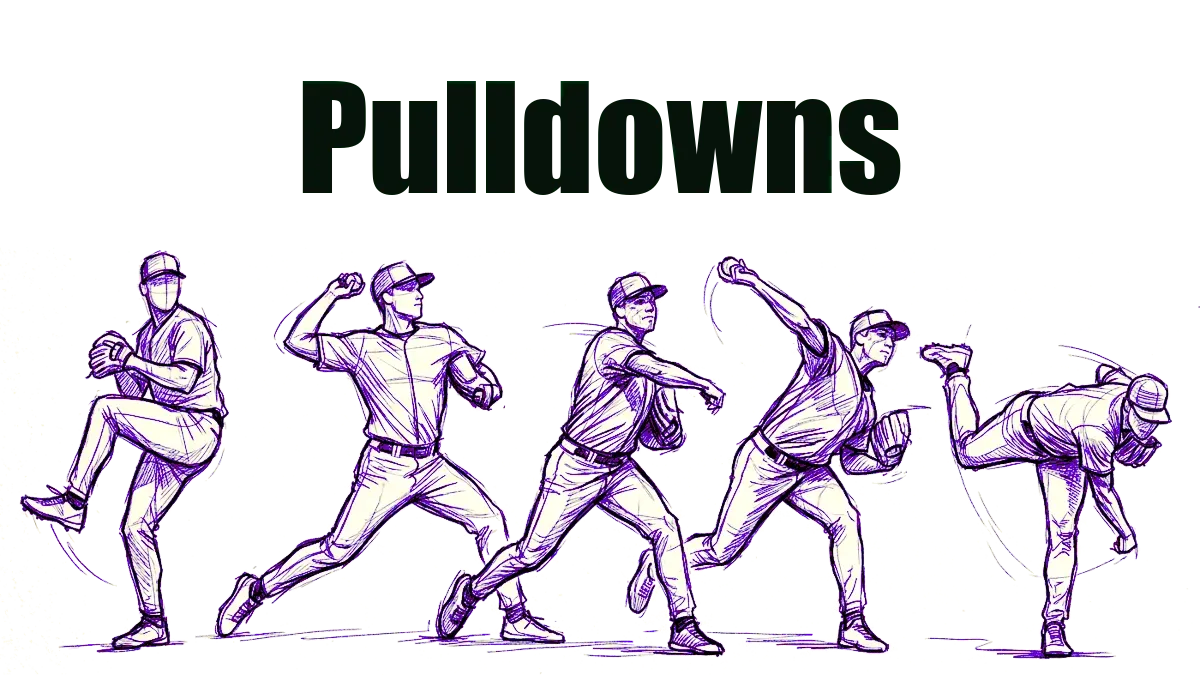
In baseball and throwing velocity training, a pulldown, sometimes referred to as a compression throw, is a maximum-intent throw where the athlete throws as hard as possible on a flat trajectory (on a line) rather than with a high arc, as you would in long toss.
A baseball pulldown is a much more common throw type in baseball games due to the speed required to throw out runners attempting to get on base or get an extra base.
It is designed to simulate high-velocity pitch delivery mechanics or an outfielder's throw to the plate or even a shortstop's throw to first base.
Why perform a baseball pulldown?
Athletes perform baseball pulldowns (running throws or compression throws) for five core reasons grounded in movement science and athletic development, but the reality is, they do a lot of good automatically.
In summary, it helps players get out of their own heads, stop holding their own bodies back, and throw efficiently.
1. Training High Intent & Removing Internal Inhibition
Pulldowns strip away the internal distractions and train raw intent, the single-minded neuromuscular effort to move as fast as possible.
In short, players, especially pitchers, will get in their own head about mechanical cues and stop throwing athletically.
The pulldown is designed to stop overthinking and simply throw the ball as hard as possible.
2. Bridging the Gap Between Range of Motion & High-Speed Output
Bringing the ball down "on a line" forces the body to convert range of motion into explosive linear momentum. It takes the elastic stretch and conditions the core and shoulders to snap shut under intense speed.
In short, pulldowns require and train the body to move quickly, which is exactly what it takes to throw faster.
3. Forcing Kinetic Chain & Front-Leg Efficiency
Forcing maximum intent throws exposes mechanical flaws.
Two examples:
- Without proper lead-leg blocking, the ball will typically travel high. To keep a 90+ mph throw from flying high or bouncing, the front leg must hit the ground and lock firm. Typically referred to as a lead-leg block. This converts forward momentum into a violent torso rotation.
- Low-trajectory throws require aggressive forward trunk tilt over the front leg at release, forcing optimal energy transfer through the chest and spine rather than letting the arm do all the work.
In short, pulldowns will expose, and sometimes automatically fix, bad throw mechanics that long toss or catch play doesn't reveal.
4. Controlled Mechanical Stress & Supercompensation
To build tissue tolerance and peak velocity in the off-season, an athlete needs a stimulus that meets or slightly exceeds game stress.
Biomechanical research from ASMI (American Sports Medicine Institute) demonstrates that throwing a 5-oz ball with a running crow-hop places joint torque on the elbow and shoulder that is similar to, or slightly higher than, pitching off a mound.
Exposing the body to this stress in a progressive, controlled training environment triggers the body's supercompensation cycle, building stronger tendons, connective tissue, and decelerating posterior shoulder muscles to handle game workloads.
In short, by applying high-intent exercise, like max-intent pulldowns, followed by rest, the body doesn't just recover to baseline. It over-corrects, building stronger tissue, denser tendons, and better neuromuscular pathways.
5. Establishing Throwing Velocity Potential
Pulldowns act as a diagnostic tool to evaluate an athlete's physical ceiling. Research shows a strong correlation between pulldown velocity and peak mound velocity.
In short, if you have high pulldown velocity but a low mound velocity, you have a pitching mechanical failure. If you have a low pulldown velocity, it tells you to prioritize general force production, athletic motor building, or intent training before worrying about mound mechanics.
Pulldown is NOT One-Size-Fits-All
Depending on the age and position of the player, you'll need to customize the pulldown work.
Your initial goal, especially for younger players, will need to be mastering the crow-hop mechanics and learning to brace with the lead leg.
You should shoot for a maximum of 2 sessions per week (72 hours apart), but make sure to check in with the thrower before starting a session to verify they don't have any arm pain.
For rough estimates, based on position:
- A pitcher needs max speed from 40-60 feet.
- A shortstop or infielder needs max speed from 40-127 feet.
- An outfielder may need max speed from 100-300+ feet.
Don't Ignore Health and Workload
While keeping Nikolai Yakovlev’s supercompensation theory in mind, we shouldn't work on pulldowns without a 48- to 72-hour rest period. Be sure to check with your athlete prior to starting a pulldown session. Ask about any pain, discomfort, or health issues they have and take a break if they are not feeling 100%.
Here are a few general rules to keep the player healthy:
- Strict 72-Hour Spacing: Max-intent sessions are limited to 2 days per week (e.g., Tuesday and Friday or Wednesday and Saturday).
- Standard 5oz Baseballs Only: For initial onboarding, avoid heavy plyo balls or underload/overload variations until the movement pattern is fully mastered.
- Flat Trajectory Rule: A throw only counts if the launch angle is low (~5°–15°) and hits the receiver at chest height. Lofted high-arc throws do not qualify as pulldowns.
- Immediate Stop Rule: If an athlete experiences sharp medial elbow pain, shoulder pinch, or dropping velocity, the session ends immediately.
Difference Between Feel & Fact
As the old adage says, "Feel is a liar; data is the truth."
Feel is an important part of baseball, but data will get you farther. A pulldown should be:
- Measured with a radar gun.
- flat on a line (5°–15°) to test true horizontal hand speed.
- 48 hours or 72 hours of rest are important for body growth. Even if the player feels good, be sure to give them rest.
You aren't actually pulling down vertically. High-speed video shows your arm accelerating on a clean, late extension plane through a natural release slot.
True pulldowns use the momentum of the crow-hop or the shuffle step so the lower half and core do the heavy lifting. The arm is just a whip finishing the sequence.
Focus On Process First; Outcome Will Follow
If you only focus on the outcome, you'll burn out or quit before any gains are made. Create an 8-week throwing routine.
- Process-Focused: Concentrating on aggressive footwork, building momentum during the crow-hop, bracing a firm front leg, and letting the torso whip open.
- Outcome-Driven: Muscling the ball with the neck, shoulder, and arm to "crack the whip," which bleeds velocity and spikes elbow stress.
- The Reality: When you execute the mechanical process efficiently, high velocity becomes a natural byproduct, not a forced strain.
Biomechanics & Modern Movement Science of the Pulldown
In modern movement science and sports biomechanics, a baseball pulldown (or compression throw) is analyzed not just as an upper-body action, but as a full-body kinetic energy amplifier.
Because a pulldown utilizes a running start or crow-hop, it removes the static constraints of a standard pitching delivery and exposes the musculoskeletal system to higher linear momentum, peak hand speeds, and unique mechanical stresses.
Horizontal Force Vector & Ground Reaction Forces (GRF)
Unlike a mound pitch, where you can create energy using the downward slope, the pulldown requires you to generate massive horizontal momentum.
• The Physics: The athlete aggressively pushes into the turf during their crow-hop, translating horizontal ground reaction forces straight toward the target.
• The Benefit: This teaches the body how to absorb and redirect high-velocity linear momentum into rotational velocity, mimicking an outfielder racing to field a ball and throwing across the diamond.
The Lead-Leg Dynamic Brace (Energy Transfer)
A lot of times the lead-leg is thought to be the "brake," but that's a terrible analogy. Instead, the lead-leg is the energy transducer. It converts the forward-moving energy, aka linear energy, into rotational energy that powers the arm through the body.
- The Physics: The lead knee must rapidly extend and lock into a firm brace by rotating the hips. According to the conservation of angular momentum, stopping the linear translation of the lower body instantly whips the rotational energy upward into the pelvis and trunk.
- The Benefit: A soft, collapsing front knee "leaks" energy, forcing the shoulder and elbow to overwork to generate velocity. A rigid, fast-bracing front leg maximizes energy transfer up the kinetic chain.
Torsional Loading & The Stretch-Shortening Cycle (SSC)
The pulldown will cause the hips and shoulders to stretch and contract quickly, creating the stretch-shortening cycle (SSC). The SSC is a natural muscle function where an active muscle stretches immediately before it shortens, using spring-like elastic energy and reflexes to produce greater force and power than a contraction from a dead stop.
- The Physics: As the pelvis opens toward the target upon foot plant, the upper torso temporarily remains closed. This twists the spine and stretches the abdominal obliques and fascial slings like a rubber band.
- The Benefit: This extreme stretch triggers the stretch-shortening cycle (SSC), causing the core and chest to recoil forward with explosive speed. This snap is what produces maximum hand velocity without relying purely on muscular strain.
The Mental Game of Throwing Faster
Pulldowns are a great way to "get out of your head" and "just throw hard".
Renowned motor learning research (pioneered by Dr. Gabriele Wulf) shows that where you place your attention dictates how efficiently your body moves.
Focusing on mechanics like "Keep my elbow up", "Pull down hard with my lat" is the enemy of speed. By focusing on mechanics, like what happens when pitching, you cause micro-hesitations in the kinetic chain, which slows down neural firing.
Instead, focus on the effect of the movement with mental cues like "Throw through the target" or "Send the ball" to unlock velocity from every player.
During a pulldown, elite throwers stop thinking about mechanics entirely. Their mind is 120 feet away at the target, allowing the subconscious athletic engine to organize the movement automatically.
Different Ages & Different People Have Different Personal Records
Emphasizes recovery, warm-ups, arm care, and balanced movements.
Explains why the movement works using clear, simple mechanics.
Adjusts drills to fit the kid's current size, strength, and style.
How to Perform a Baseball Pulldown Correctly
Pulldowns are one of the more aggressive velocity tools. For a 12- to 18-year-old, the safe version uses low volume and a regulation baseball.
Ground Rules
- Use a standard 5 oz baseball only. No weighted balls at this age.
- Do them once a week on Thursday, replacing that day’s long toss. Don’t do both.
- Never go 100% effort. Cap intent at about 90% even in the final weeks.
- Do the full warm-up and band arm care first.
- Stop the session if he feels pain, his mechanics fall apart, or his arm feels heavy. If he’s sore the next day, drop back a level.
Setup
He takes a 3-5 step run-up and throws to a net or target 50-60 feet away. Cues:
- Build speed toward the target.
- Land on the front foot like a pitching stride.
- Hips open first, then shoulders.
- Follow through and keep moving instead of freezing at release.
Session Flow (about 25 min)
- Dynamic warm-up and arm care circuit.
- 15-20 catch play.
- Long toss until you're at your maximum distance (backing up about 5-10 feet after each throw).
- Pulldowns 8-15 MAX. I like throwing from 60 feet, but some like to throw from max distance. Come in 15 feet, throw again, and work your way back in.
- Cool down with light band work and stretching.
Keep at least 2 days of rest between pulldowns and pitching. A weekly session is plenty, since more doesn’t mean faster at this age.
I like to track every pulldown and log it in my app, but a paper or spreadsheet will work fine too. Then you get the average pulldown velo for the day and compare it to your other weeks.
Pulldowns Drills
I've sorted these from most simple to most complex. My recommendation: start with the simplest week 1. Then move to a more complex one once you've mastered your current step.
Standing Pulldown: Stand with your side at the target on flat ground. Lift your lead foot and pull it away from your target, coiling your hips. Push off your back foot, plant your lead foot, twist your shoulders, and throw. Remember: front foot plant, hips rotate, shoulders rotate, arm throws.
Drop-Step Pulldown: Stand with your side at the target on flat ground. Lift your lead foot and pull it away from your target, coiling your hips. Push off your back foot, plant your lead foot, twist your shoulders, and throw.
Drop-Step Pulldown: Discussed by Rotational Athlete Solutions, you stand with your back to the target. Turn your back foot and step towards the target, then transition forward.
Shuffle-Step Pulldown: PRP Baseball has an example video. You take a few side steps towards the target, replace your front foot with your back foot then go into your throw.
Run & Gun: Shown by Driveline Baseball, where you run in, plant your front foot, and throw. These are the most common type. You're gathering momentum by running a full sprint into a max-effort throw into a net. This removes the rigid constraints of a pitching mound, allowing you to move as fast and explosively as possible.
Pulldowns Routine
Day 1: Field & throws. Ground balls. Pop flies. Etc. Throws are low to medium intensity. You can mix up the throws from standing, moving to the left, moving to the right, moving forward, moving backwards, bent over, from the knees, etc. Remember, baseball is supposed to be fun, so have some fun with it.
Day 2 & Day 3: rest.
Day 4: Warm up with a catch that focuses on hips, then shoulders, then arm. Loss tosses on the way out. Once they hit max distance, pulldowns on the way back in. 8-15 Pulldowns max.
Day 5 & Day 6 rest.
Day 7: Pitching. 50 pitches. Max intent/game mode. After warming up. The first 10 are fastballs that are getting caught on the radar.